Researchers at Lawrence Livermore National Laboratory (LLNL) have developed an innovative simulation technique that enhances the understanding of crystal defects at realistic temperatures. Published in Physical Review Letters, this study addresses longstanding challenges in materials science, paving the way for improved production and performance of various materials.
Most materials, particularly metals and ceramics, exist as crystalline structures where atoms are arranged in repeating three-dimensional lattices. A notable saying in materials science highlights the role of imperfections: “Crystals are like people. It is the defects that tend to make them interesting.” This new model focuses on two prevalent types of defects: point defects and grain boundaries. Point defects occur when there are missing atoms or when additional atoms occupy spaces in the lattice, while grain boundaries are the interfaces where two differently oriented crystals meet.
Understanding and Modeling Defects
Point defects and grain boundaries significantly influence a material’s properties. As Flynn Walsh, a postdoctoral researcher at LLNL, explains, “Cracks often find it easier to grow along grain boundaries, which can cause materials to fracture.” This insight is crucial for applications ranging from protective walls in fusion energy plants to the magnets that power electric motors.
To enhance technology reliant on these materials, researchers must comprehend the dynamics of crystal structures in complex defects like grain boundaries. While imaging these defects is possible, the experiments can be extremely challenging. Thus, effective modeling becomes essential.
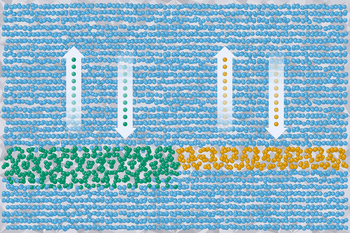
The new simulation technique introduces a paradigm shift by allowing atoms to come and go within the simulation. Traditional methods involved directly adding or removing atoms, which proved ineffective in solid crystals due to high energy barriers. Instead, this method gradually adjusts the atomic configuration, mimicking natural processes where atoms shift to achieve stable states.
Walsh notes, “Instead of abruptly shoving an atom through a packed crowd of its fellows, the model softly pushes or pulls it into place.” This nuanced approach enables predictions of grain boundary structures and phase transitions at finite temperatures, marking a significant advancement in the field of materials science.
Implications for Extreme Environments
According to Timofey Frolov, a scientist at LLNL and principal investigator on the project, “For the first time, this new technique opens the door to predicting grain boundary structures and phase transitions at finite temperatures.” This capability is especially relevant for materials used in extreme environments, such as those found in fusion reactors.
While the method requires substantial computational resources, it has greatly benefited from LLNL’s supercomputing capabilities. Walsh emphasizes the importance of the collaborative research environment at LLNL, stating, “I was able to think deeply about this problem for a year and half with the guidance of experts in different areas of physics and materials science.” Other contributors to the study included Babak Sadigh and Joseph McKeown.
The research received funding from Frolov’s U.S. Department of Energy early career project and McKeown’s Laboratory Directed Research and Development Strategic Initiative. The LLNL Institutional Computing Grand Challenge provided essential computational resources for the study.
This groundbreaking work not only advances the understanding of crystal defects but also holds promise for enhancing material applications across various industries, ultimately leading to better technologies in the future.