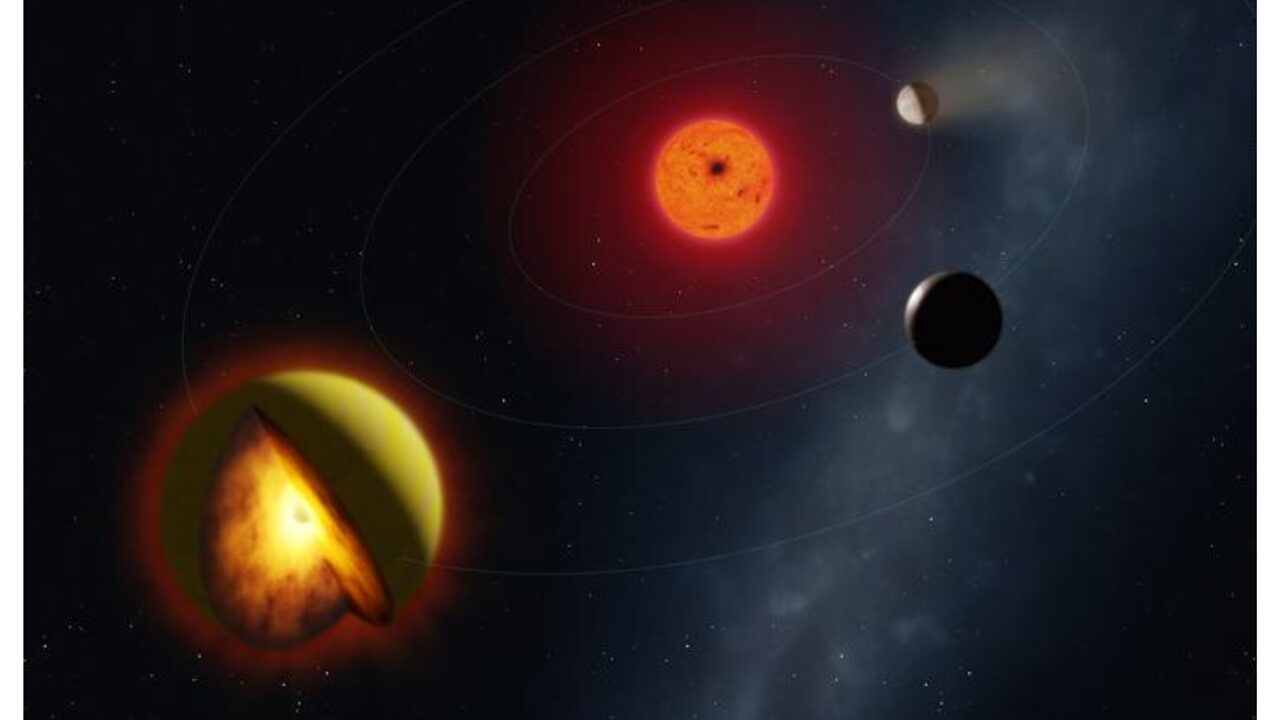
Astronomers have made a groundbreaking discovery using the James Webb Space Telescope (JWST), revealing a new type of exoplanet that likely emits a scent reminiscent of rotten eggs. Designated L 98-59 d, this molten lava world orbits a small red star located approximately 35 light-years from Earth, indicating a far broader range of planetary diversity than previously understood.
The data collected from the JWST, alongside observations from various Earth-based telescopes, suggests that L 98-59 d is about 1.6 times the size of Earth and possesses an extremely low density. Its atmosphere is rich in hydrogen sulfide, a compound notorious for its distinctive odor. Traditionally, planets like this would fall into existing classifications such as rocky gas dwarfs or water-rich “hycean” worlds. However, L 98-59 d does not fit neatly into either category, prompting astronomers to propose a new classification focused on exoplanets abundant in heavy sulfur molecules.
A New Perspective on Planetary Classification
“This discovery suggests that the categories astronomers currently use to describe small planets may be too simple,” stated Harrison Nicholls, the lead researcher from the University of Oxford. “While this molten planet is unlikely to support life, it reflects the wide diversity of the worlds which exist beyond the solar system. We may then ask: what other types of planets are waiting to be uncovered?”
To understand the unique characteristics of L 98-59 d, Nicholls and his team employed advanced computer simulations to reconstruct nearly 5 billion years of the planet’s history. By comparing these models with actual telescope data, they gained insights into the processes occurring beneath the planet’s surface. Their findings suggest that L 98-59 d likely has a mantle composed of molten silicate, akin to the lava found on Earth, along with a global ocean of magma.
This expansive magma ocean plays a crucial role in the planet’s geological processes, enabling it to sequester significant amounts of sulfur over extensive periods. Over billions of years, sulfur-rich gases, including sulfur dioxide and other sulfur-based compounds, have accumulated in the planet’s atmosphere, as detected by the JWST.
Uncovering the Secrets of Alien Worlds
The research also indicates that the magma reservoir may have helped L 98-59 d retain its hydrogen and sulfur-rich atmosphere, despite the intense X-ray bombardment from its parent star. The continuous exchange of molecules between the atmosphere and the planet’s interior has resulted in the development of a new class of gas-rich, sulfurous planets that maintain long-lived magma oceans.
The team’s simulations indicate that L 98-59 d was likely born with a substantial amount of volatile material and may have originally been a larger sub-Neptune planet. Over billions of years, it has undergone significant shrinkage and cooling, losing some but not all of its atmosphere.
“What’s exciting is that we can use computer models to uncover the hidden interior of a planet we will never visit,” remarked Raymond Pierrehumbert, another member of the research team at the University of Oxford. “Although astronomers can only measure a planet’s size, mass, and atmospheric composition from afar, this research shows that it is possible to reconstruct the deep past of these alien worlds—and discover types of planets with no equivalent in our own solar system.”
The team’s findings were published on March 16, 2024, in the journal Nature Astronomy, marking a significant advancement in our understanding of planetary diversity beyond our solar system. As astronomers continue to explore the cosmos, the discovery of L 98-59 d raises intriguing questions about the existence of other unusual worlds yet to be discovered.