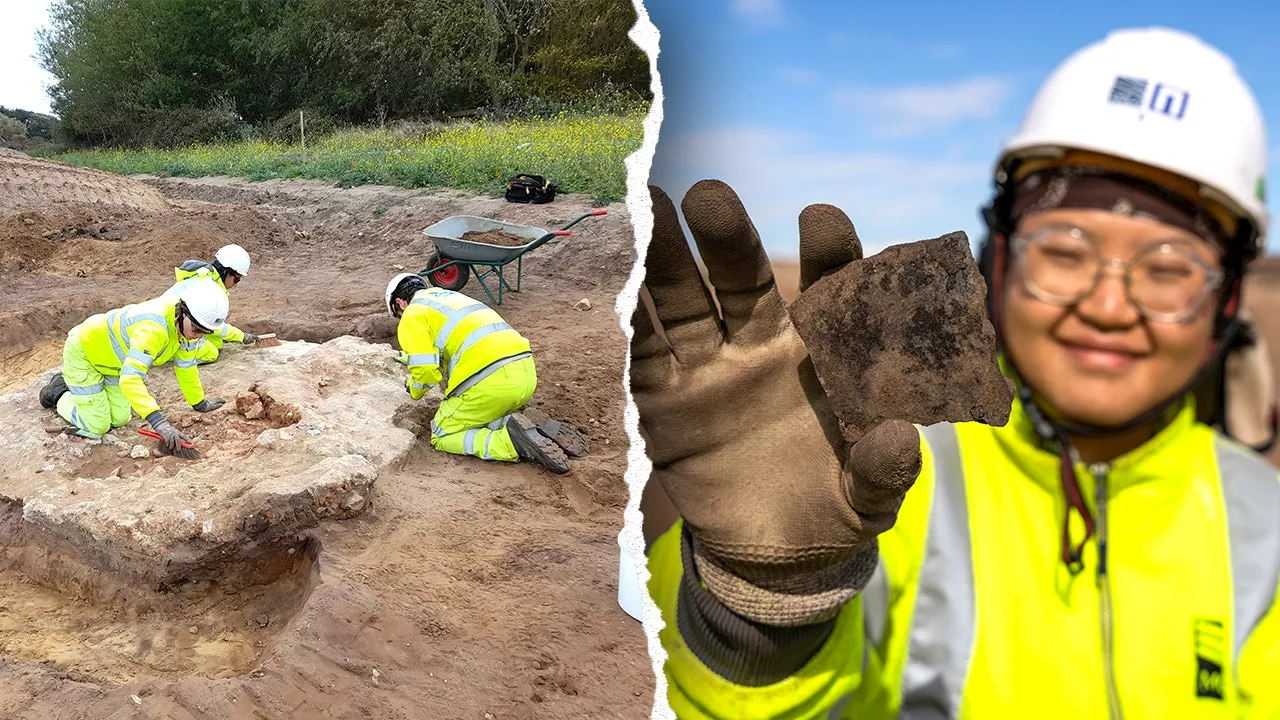
Archaeologists have unearthed the remains of a previously unknown Anglo-Saxon village during pre-construction excavations for an offshore wind farm near Friston, England. The discovery, announced on December 9, 2023, reveals a settlement that dates back to the Anglo-Saxon period, characterized by wooden longhouses and various artifacts, including flint tools and pottery fragments.
The excavation, led by Wessex Archaeology in collaboration with the Museum of London Archaeology, highlighted a small community that lived in substantial wooden structures. According to officials, these longhouses served not only as living spaces but also as social hubs, featuring a central hearth for cooking and warmth. Despite the wooden buildings having decayed over time, post holes indicate their substantial size, measuring up to 19 meters long and 6 meters wide.
Among the significant finds were ancient artifacts, such as an arrowhead believed to be between 4,000 and 6,000 years old. This arrowhead is particularly notable for its design, which allowed it to cover long distances for hunting. The fragile nature of its sharp edges typically results in breakage during burial, making this a rare and valuable discovery, as emphasized by Wessex Archaeology.
The excavation was conducted as part of the development for the East Anglia TWO and ONE North Projects, an offshore wind farm initiative by ScottishPower Renewables. Senior Project Manager Matthew Ginnever at MOLA-Wessex Archaeology described the most intriguing finds, including medieval kilns and fragile ancient flints, consisting of arrowheads and an axe head.
An exciting aspect of the discovery is the alignment of a modern public right of way with the early medieval buildings. This suggests that the footpath may have been in continuous use since the Anglo-Saxon period or even earlier, according to Ginnever.
The village is believed to have been abandoned in the 1300s, although the reasons for this remain unclear. Ginnever noted that excavations have been focused on key points where onshore development is planned, such as substations. The team aims to explore these findings further during the post-excavation analysis phase and plans to share additional insights in a webinar scheduled for January 23, 2024.
This is not the first time that modern construction projects in Europe have led to significant archaeological discoveries. Last year, similar excavations in Suffolk revealed a treasure trove of artifacts dating back a millennium at a nuclear power plant site. Additionally, Czech excavators recently uncovered multiple military graves linked to the Austro-Prussian wars during highway construction.
The findings at Friston contribute to our understanding of early medieval life in England and underscore the importance of archaeological oversight in contemporary development projects. The team at Wessex Archaeology is committed to further research and sharing their discoveries with the public as they continue their work.