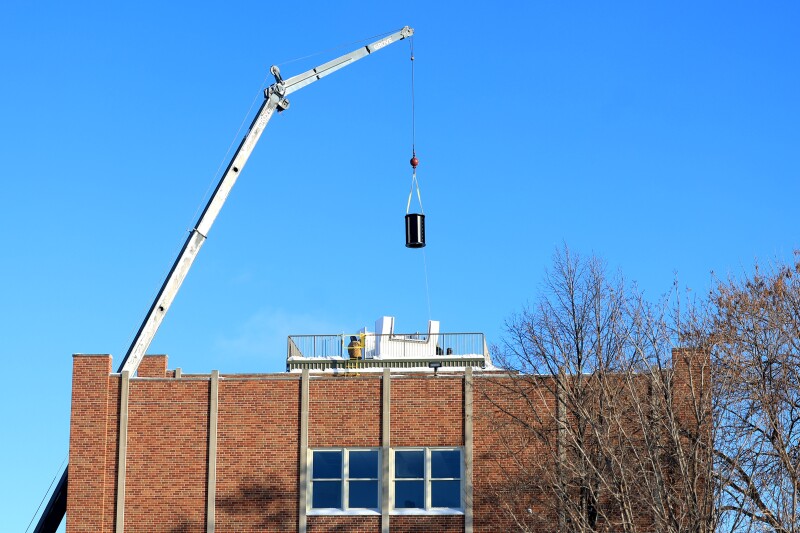
A new laser communication laboratory at the University of North Dakota (UND) has been established to facilitate satellite communication for local customers and university students. This initiative was spearheaded by assistant professor of physics and astrophysics, Markus Allgaier, who worked closely with UND Facilities and local contractors to bring the project to fruition.
The Free-Space Optical Communication Lab is divided into two sections located at the top and bottom of Witmer Hall. The facility features an observatory and telescope on the rooftop, equipped with optics designed to transmit lasers to satellites and receive laser light data from them. According to Allgaier, this capability represents a significant technical challenge.
The installation of the observatory was initially scheduled for December 9, 2023, but adverse weather conditions postponed it to the following day. Wind and light snow further delayed the process until 13:00. Reflecting on the experience, Allgaier expressed both excitement and stress: “I’ve not had a project ever in my career where you’re planning for two and a half years and then it comes down to one day.”
Below the observatory, a standard laser lab will connect to the rooftop facility via optical fibers. This lab is designed to maintain a stable temperature and features specialized tables that minimize vibrations during experiments. The project aims not only to create a comprehensive facility for laser communication, adhering to commercial standards, but also to cater to research needs in the region.
This lab addresses specific local requirements, as the Space Development Agency will operate a satellite partially from the Grand Forks Air Force Base. Local contractors involved in daily satellite link operations are actively recruiting from UND. “We can train students from the region for jobs in the region that need that kind of skill,” Allgaier noted.
Funding for the lab was secured through a request made by UND before the 2023 legislative session. The university successfully obtained $5 million for this infrastructure project, which was reinvested into the local economy by hiring regional contractors such as Sand Steel from Emerado and AE2S.
Students have already begun utilizing the basement lab for experiments. Among Allgaier’s students, three are pursuing PhDs, one is working on a Master’s degree, and several undergraduates are engaged in senior projects. Allgaier is considering the introduction of an upper-level elective course focused on optics and potentially another course related to lasers in the future.
The facility will be accessible to all students at UND, fostering collaboration across disciplines. As Allgaier described, “It’s taking a little bit of shape of what that collaboration is going to look like and who might use it, and for what kind of things and what collaborations we’re going to have.”
Allgaier began planning this project before relocating to Grand Forks for his role at UND. He officially joined in January 2024, having signed his contract in March 2023. During the summer and fall prior to his move, he engaged with contractors to assess what could be achieved within the allocated budget.
Having previously built three optics labs in other positions, this project at UND allowed him to create a “wish list” of desired features. “The technology has been a chicken-and-egg problem,” Allgaier explained. This lab is one of the first of its kind, following the inaugural ground station constructed by the Space Development Agency.
According to Allgaier, the challenge lies in the perception of technology. When proponents of laser communication suggest building ground stations, skeptics argue that there are no missions to utilize lasers. Conversely, when missions with laser communication are proposed, opponents highlight the lack of ground station infrastructure. “You need to overcome by putting a little bit of faith in that, that this will be a technology that will be used,” he concluded.
By the end of spring 2026, all hardware will be installed in the lab, though it will take additional time to fully operationalize the facility. This project represents a significant advancement in research capabilities at UND and a step forward for satellite communication technologies.