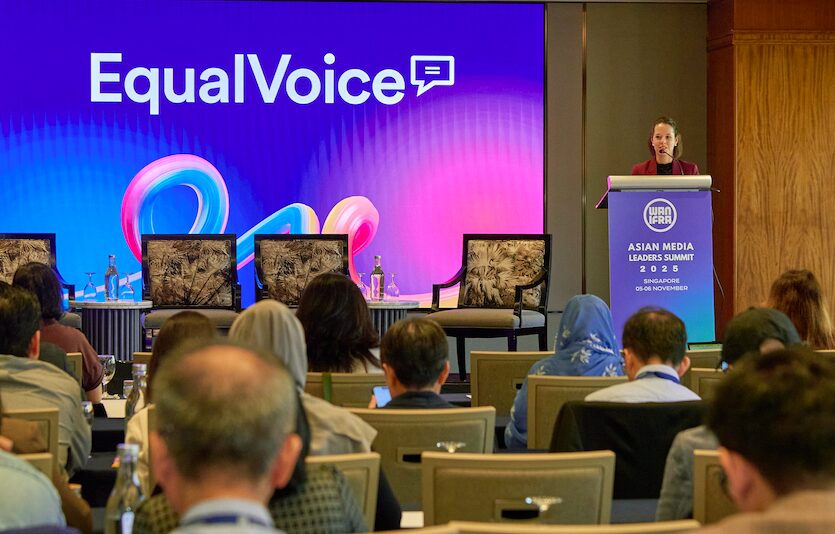
During the Asian Media Leaders Summit in Singapore, Lea Eberle, Head of Finance Projects at Ringier, addressed persistent issues of bias in journalism, particularly focusing on gender representation. Eberle emphasized that both conscious and unconscious biases influence media coverage, revealing significant disparities in how men and women are portrayed.
Eberle highlighted a striking statistic: although women represent 40% of all athletes globally, they appear in only 4% of sports media articles. This imbalance extends beyond sports, as evidenced by the lack of female representation in Switzerland’s largest business magazine, Bilanz, which has featured women on its covers infrequently over the past 25 years.
Biases also infiltrate technology, Eberle noted. A study conducted by Ringier in collaboration with Microsoft and IMD Business School found that artificial intelligence systems can perpetuate stereotypes. When prompted with “CEO,” AI results overwhelmingly depicted white males over 40 years old. Conversely, the prompt “business woman” resulted in images of a young white woman in suggestive poses. Eberle pointed out that if AI lacks diverse data, its outputs will reflect the same biases.
Recognizing and addressing these biases is crucial for media organizations. As Eberle stated, “We need to change the narrative within our publications, but also for the future within AI.” This commitment is exemplified by Ringier’s EqualVoice initiative, launched in Switzerland in 2019. The project aims to confront gender biases in media by focusing on visibility and representation.
The EqualVoice initiative uses a data-driven approach to analyze what Eberle calls the “EqualVoice-Factor,” which measures the visibility of women in various media formats, including text, images, video, and audio. This algorithm was developed in-house at Ringier and has been fact-checked in collaboration with ETH Zurich, a leading university in Zurich. The analysis delves into the representation of women, examining the questions posed to them, the imagery used, and the adjectives that accompany their portrayal.
Eberle believes that increasing the visibility of women in diverse roles can inspire young girls to aspire to those positions. She asserts, “If we can see women in every role in our everyday lives, then little girls… believe they can become this role and change the narrative about stereotypes.”
Beyond focusing solely on women’s representation, the EqualVoice initiative also aims to challenge stereotypes about men. Eberle pointed out that in European media, men are rarely depicted in nurturing roles, such as fathers or caregivers. This lack of representation can hinder efforts to reshape societal views on masculinity. “We call it EqualVoice because it’s equally important to address stereotypes for men,” she added.
Since the initiative’s inception, business publications in Switzerland have significantly improved their EqualVoice-Factor, rising from 17% to over 34%. This increase reflects a doubling of the number of women featured in these publications. Currently, EqualVoice serves 32 newsrooms across seven countries, reaching approximately 50 million users.
To further enhance media representation, the initiative introduced the EqualVoice-Assistant, an AI tool integrated within content management systems. This assistant flags potential biases and stereotypes in articles prior to publication, offering alternative suggestions. Eberle emphasized the importance of educating journalists to avoid perpetuating stereotypes, stating, “We want to improve so we don’t reproduce stereotypes anymore.”
In just one year, the EqualVoice-Assistant has been implemented in four countries, analyzing over 32,000 articles each month across Ringier’s newsrooms, benefiting more than 730 users.
Addressing the gender gap in media is a long-term challenge. Citing the World Economic Forum’s Global Gender Gap Report, Eberle noted that it could take up to 123 years to close the gender gap at the current rate. Ringier is not willing to wait that long. Eberle stressed the need for collective action within the media industry to combat unconscious biases and enhance gender equality. “Gender equality and diversity change needs time,” she acknowledged, “It’s not a sprint, it’s a marathon.”
For further information about Ringier’s EqualVoice initiative and its impact, visit their official website.