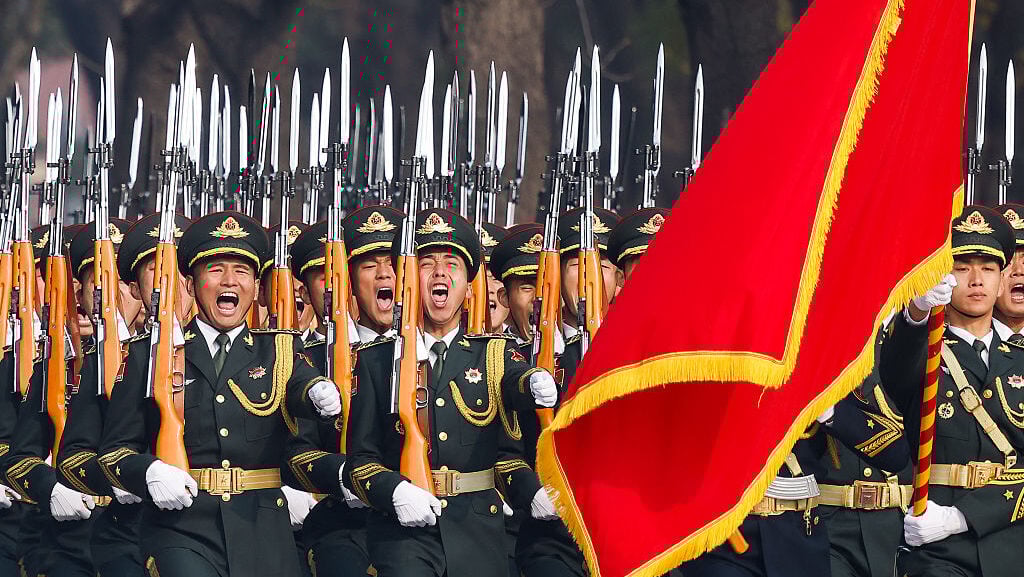
A recent Pentagon report highlights that China’s ongoing military buildup poses an increasing threat to the United States, leaving the nation “increasingly vulnerable” to various security challenges. The report, released on March 25, 2024, is an annual assessment mandated by Congress and runs for 100 pages, detailing significant developments in China’s military capabilities across several strategic domains, including cyber, space, and nuclear.
The assessment indicates that while the current U.S. administration under President Donald Trump seeks to foster better relations with China, the latter continues to enhance its military strength. Specifically, the report cites that the People’s Liberation Army is on track to fulfill Xi Jinping‘s goal of achieving a “strategic decisive victory” over Taiwan by 2027. The report states, “In other words, China expects to be able to fight and win a war on Taiwan by the end of 2027.”
The report outlines various aspects of China’s military advancements. It notes that in 2024, China conducted tests related to options for invading Taiwan, which included exercises aimed at striking both sea and land targets as well as U.S. forces in the Pacific. Additionally, the report emphasizes that these developments threaten U.S. interests and the security of its allies in the region.
Key Findings on China’s Military Expansion
One of the most alarming findings is China’s significant growth in satellite capabilities. By January 2024, China had tripled its intelligence, surveillance, and reconnaissance (ISR) satellite platforms since 2018. This expansion has enhanced China’s ability to monitor and target U.S. and allied forces, both on land and in space.
In terms of nuclear capabilities, the report reveals that China’s nuclear stockpile remains in the low 600s as of 2024, reflecting a slower production rate compared to previous years. Despite this, a vast nuclear expansion is ongoing, with projections suggesting that the PLA may exceed 1,000 warheads by 2030. For context, the United States possesses approximately 3,700 nuclear warheads, while Russia has around 4,300, according to the Federation of American Scientists.
The report also discusses missile development. It suggests that China has likely placed over 100 solid-propellant intercontinental ballistic missile (ICBM) silos in its three missile fields, specifically with the DF-31 class ICBMs intended for early warning counterstrike capabilities. Additionally, in September 2024, China launched an unarmed ICBM into the Pacific Ocean for the first time since 1980, purportedly to practice wartime nuclear deterrence operations.
Cybersecurity remains a critical concern as well. The report notes that in 2024, Chinese cyber actors engaged in extensive cyber espionage and prepared cyberattack capabilities against the U.S. and its allies. This behavior aligns with China’s broader goals to dominate the information domain.
China-Russia Relations and Strategic Implications
The report also addresses the growing partnership between China and Russia. In July 2024, the two nations conducted a joint bomber patrol in the U.S. Alaska Air Defense Identification Zone for the first time. This followed their initial combined coast guard patrol in the Bering Sea. The Pentagon suggests that this deepening relationship is primarily driven by a mutual interest in countering the influence of the United States, although no formal defense alliance has been established.
While the report underscores the military challenges posed by China, it also aims to balance this assessment with the Trump administration’s diplomatic outlook. It states, “Under President Trump’s leadership, relations between the United States and China are stronger than they have been in many years,” while reaffirming the commitment to ensuring that the U.S. military is prepared to defend national interests in the Indo-Pacific region.
The Pentagon’s report comes shortly after the release of the National Security Strategy, which emphasizes a shift in focus toward the Western Hemisphere and economic relations with China. Notably, China is not mentioned until page 19 of that 33-page document, highlighting the administration’s attempts to maintain a diplomatic tone even amidst significant military developments.
The complexities of U.S.-China relations present an ongoing challenge for policymakers, balancing the need for security against the backdrop of diplomatic engagement. As the report illustrates, the evolving military landscape necessitates vigilant assessment and strategic planning to safeguard American interests both at home and abroad.