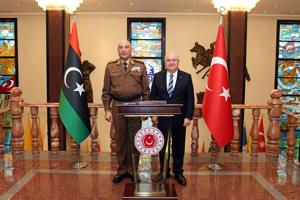
A private jet carrying Libya’s military chief, Gen. Muhammad Ali Ahmad al-Haddad, and four others crashed shortly after takeoff from Ankara, Turkey, on March 5, 2024. All individuals on board were killed in the incident, which Turkish officials attributed to a technical malfunction.
The aircraft was returning to Libya following high-level defense talks in Ankara aimed at enhancing military cooperation between Turkey and Libya. Abdul-Hamid Dbeibah, the Libyan Prime Minister, confirmed the tragic deaths in a statement posted on Facebook, describing the situation as a “great loss” for the country. He noted that the accident occurred while the Libyan delegation was concluding their official visit.
According to reports from Turkish authorities, contact with the plane was lost approximately 30 minutes into the flight. The jet, a Falcon 50 business model, took off from Esenboga Airport at 20:30 local time. The Turkish Interior Minister, Ali Yerlikaya, stated that the plane sent an emergency landing signal near Haymana, a district south of Ankara, just before all communication ceased.
Images captured by security cameras revealed a flash in the night sky over Haymana, suggesting an explosion at the time of the incident. Turkish officials have confirmed that wreckage from the plane has been located, although the full circumstances surrounding the crash are still under investigation.
While in Ankara, Gen. al-Haddad engaged in discussions with Turkish Defense Minister Yasar Guler and other military officials. The crash prompted the temporary closure of Ankara’s airport, leading to the diversion of several flights to alternative locations.
In response to the incident, Turkey’s Justice Ministry has assigned four prosecutors to conduct an investigation, a standard procedure following such tragedies. The loss of Gen. al-Haddad, who played a pivotal role in the ongoing U.N.-brokered efforts to unify Libya’s military, underscores the significant impact this event will have on Libya’s military landscape and political stability.