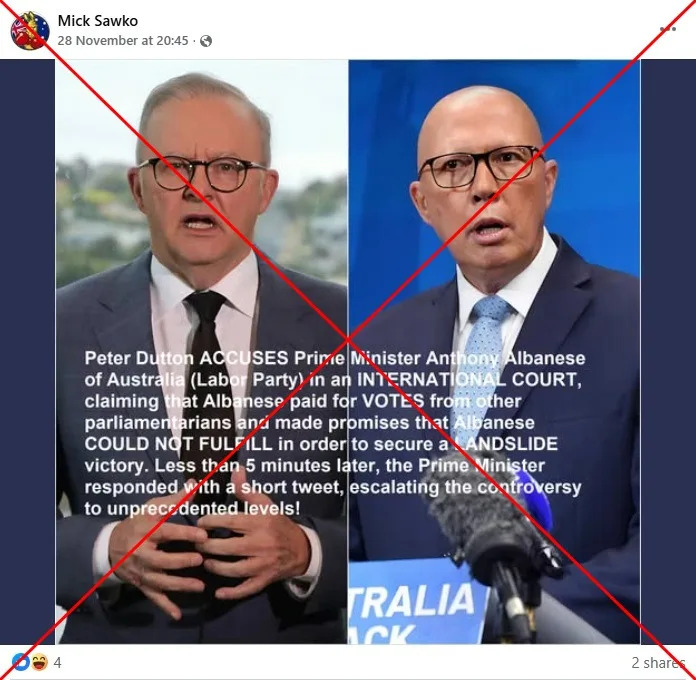
Unfounded claims suggesting that Australian Prime Minister Anthony Albanese is facing a legal challenge at an international court have been thoroughly discredited by legal experts. Following the May 2025 federal elections, where Albanese’s Labor Party secured an outright majority, social media posts falsely asserted that former opposition leader Peter Dutton had accused the Prime Minister of vote-buying.
The misleading information circulated widely, with images of the political rivals accompanied by text alleging that Dutton had formally lodged a complaint against Albanese at the International Court of Justice (ICJ). The posts claimed that Dutton accused Albanese of purchasing votes from parliamentarians and failing to fulfill promises to achieve a “landslide victory.” It further suggested that Albanese had responded publicly, escalating the situation significantly.
The Liberal Party has categorically denied these allegations. A representative stated via email to AFP on December 6, 2025, that the claims are “obviously false.” Legal scholars have reinforced this stance, clarifying that neither the ICJ nor the International Criminal Court (ICC) possesses the jurisdiction to handle such disputes.
Legal Framework and Jurisdiction
According to Richard Garnett, an expert in international legal arbitration at the University of Melbourne, the ICJ only addresses disputes between states, not individual accusations. He explained, “For example, if Australia and France had a dispute, that could be heard in the International Court of Justice, but they don’t deal with cases involving individuals.”
In a similar vein, Natalie Klein, an associate dean at the University of New South Wales Sydney’s Faculty of Law & Justice, confirmed that it would be impossible for Dutton to have made such a claim at the ICJ. The ICJ’s official communications also clarified that “individuals cannot be parties to cases before the Court.”
Furthermore, Garnett pointed out that the ICC is concerned solely with issues such as war crimes and crimes against humanity, which are outside the scope of election-related allegations like vote-buying. He stated, “So it’s more than disinformation. It’s completely absurd, complete nonsense.”
Fact-Checking and Misinformation
The false narratives have been propagated through various social media channels, including platforms like Instagram, where accounts known for disseminating misinformation about Australian politics have shared these claims. The Australian Associated Press (AAP) Factcheck previously debunked these allegations, affirming their lack of veracity.
In a December 10 email, the ICC echoed the sentiment, stating, “We can confirm that no such case exists before the International Criminal Court.” This consistent reaffirmation from multiple credible sources underscores the importance of discerning fact from fiction in political discourse.
The spread of misinformation can have real consequences, particularly in the realm of politics, where public perception is crucial. As Australia navigates its political landscape, the responsibility to uphold the integrity of information becomes ever more critical.