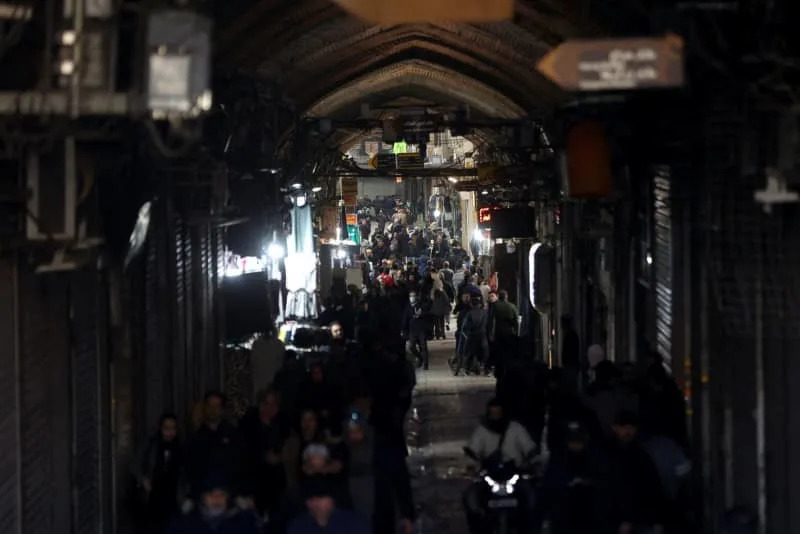
Protests have erupted across Iran as citizens express their discontent over the country’s deteriorating economic situation. Demonstrators have faced significant pushback from authorities, with reports of arrests and the use of tear gas in various cities, including Tehran and Kermanshah.
Footage from the protests shows large crowds gathering in defiance of police presence, particularly on Tehran’s Jomhuri Street, where some protesters managed to force police to retreat. Eyewitness accounts indicate that at least ten individuals were detained on Sabunian Street. Among those arrested was Mehdi Biek, the political editor of the Etemad newspaper, who was covering the events. His wife noted on social media that they had lost contact for over 24 hours before his release on Tuesday.
The protests, ignited by the rapid decline of the Iranian rial, have become a platform for broader dissent against the regime’s policies. Videos shared by dissident media captured protesters chanting, “Neither Gaza nor Lebanon, I will sacrifice my life for Iran,” reflecting a shift from purely economic grievances to political ones.
Economic instability has become increasingly severe, with the rial plummeting to 1.4 million rials per USD, a significant drop from 817,500 rials per USD at the start of 2024. This devaluation represents a nearly 90 percent loss since 2018, a crisis that has spurred public outrage.
Government Response to Unrest
Iranian President Masoud Pezeshkian acknowledged the public’s grievances during a recent statement, promising to address legitimate concerns through dialogue. He emphasized that the government is prioritizing economic reforms, including a proposal to increase government salaries by 30 percent next year, up from an initial plan of 20 percent. Despite these assurances, some officials within the regime have resigned due to the unrest, reflecting the growing discontent among citizens.
The protests are the largest witnessed in Iran since the death of Mahsa Amini, a young Kurdish woman who died in custody in September 2022. Her death catalyzed widespread demonstrations against the government, marking a significant moment in the struggle for women’s rights and personal freedoms in Iran. Rising inflation, a collapsing currency, and the government’s focus on funding militant groups abroad rather than addressing domestic issues have all contributed to the unrest.
Violence Against Student Protesters
While the government has shown some willingness to engage with protesters, the response to dissent at universities has been markedly more violent. Reports indicate that students at Tehran’s Amirkabir University faced aggressive actions from the IRGC’s Basij paramilitary forces, resulting in injuries to at least one student. Additional arrests were reported among student protesters, including individuals from various academic disciplines.
The current unrest in Iran signals a deeper challenge to the legitimacy of the Islamic Republic. As noted by dissident journalist Masih Alinejad, the protests are not merely economic in nature, but rather a profound challenge to the government’s authority. With the country facing a combination of economic collapse and widespread dissatisfaction, it remains to be seen how the Iranian regime will navigate this growing crisis.