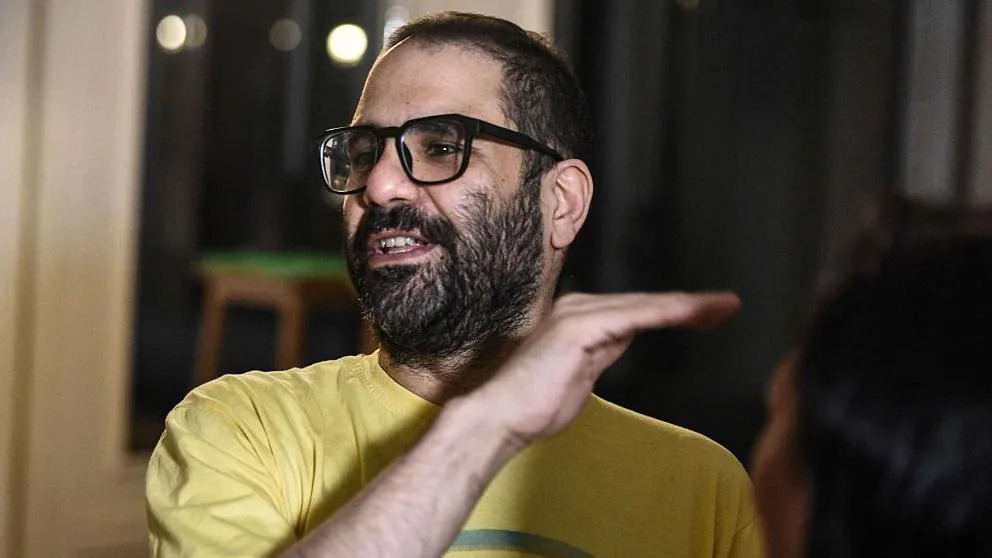
Egyptian democracy activist Alaa Abdel Fattah has issued an apology for several old tweets that have resurfaced, coinciding with rising calls for his deportation from the United Kingdom. Abdel Fattah arrived in the UK following his release from prison in Egypt, where he had spent over a decade behind bars for charges related to political dissent. Prominent leaders from the Conservative Party and Reform UK are urging Home Secretary Shabana Mahmood to examine the possibility of revoking his citizenship in light of the controversial posts.
The tweets, which include statements calling for violence against certain groups, have sparked significant backlash. Some senior Labour MPs have also expressed support for the idea of rescinding his citizenship. In response to the outcry, Abdel Fattah acknowledged the tweets’ disturbing nature, stating, “I do understand how shocking and hurtful they are, and for that I unequivocally apologise.” He further elaborated that the timing of the resurfacing tweets has been particularly disheartening, as he is reuniting with his family for the first time in twelve years.
Sir Keir Starmer, the leader of the Labour Party, has faced criticism for expressing delight at Abdel Fattah’s arrival in the UK without being aware of his historical comments. Meanwhile, Conservative leader Kemi Badenoch and Nigel Farage, leader of Reform UK, have called on Mahmood to act swiftly regarding Abdel Fattah’s immigration status. Farage emphasized that “anyone who possesses racist and anti-British views” should not be permitted to remain in the UK.
The UK Foreign Office has recognized the importance of Abdel Fattah’s release, describing it as a long-standing priority. However, they condemned his past statements as “abhorrent.” The 44-year-old activist was convicted in 2021 of “spreading fake news” in Egypt, following a trial that human rights organizations criticized for lacking fairness.
Abdel Fattah gained British citizenship in December 2021 through his mother, who was born in London, which has now come under scrutiny. Chris Philp, the Shadow Home Secretary, stated that he was unaware of these details in 2021 but is now convinced that “this man should have his citizenship revoked.” Philp described Abdel Fattah’s language as unacceptable, asserting that those who express such extreme views have no place in the UK.
Some of the tweets in question date back to 2012, with one reportedly stating, “I am a racist, I don’t like white people,” while another declared a belief in the heroism of killing “colonialists and especially Zionists.” Philp declared on BBC Radio 4’s Today programme that there is “no excuse for that kind of language.”
UK laws concerning citizenship dictate that individuals cannot be rendered stateless, and citizenship can only be revoked if they are eligible for nationality in another country. Badenoch characterized Abdel Fattah’s comments as “disgusting and abhorrent,” emphasizing the need for citizenship decisions to reflect an individual’s public statements and beliefs.
This situation has drawn attention from various quarters, including the Board of Deputies of British Jews, which expressed concern about Abdel Fattah’s past rhetoric. The board’s senior vice-president, Adrian Cohen, stated that his remarks pose a threat to British Jews and the wider public, noting a lack of thorough vetting by MPs advocating for his release.
Abdel Fattah has defended his past comments, asserting that some messages were taken out of context. He claimed that a tweet interpreted as homophobic was actually intended to ridicule homophobia itself. He further stated that his commitment to LGBTQ+ rights and his advocacy against police brutality were among the reasons for his imprisonment in Egypt.
Alaa Abdel Fattah rose to prominence during the 2011 uprising that led to the resignation of former Egyptian president Hosni Mubarak. His release in September 2023 followed intense lobbying efforts by his family and the British government, culminating in a presidential pardon. After being removed from a travel ban list that had restricted his movement post-release, Abdel Fattah has now reunited with his 14-year-old son, who resides in Brighton.
The ongoing debate surrounding Abdel Fattah’s citizenship and the implications of his past social media activity continue to unfold, as political leaders grapple with balancing national security concerns and human rights advocacy.