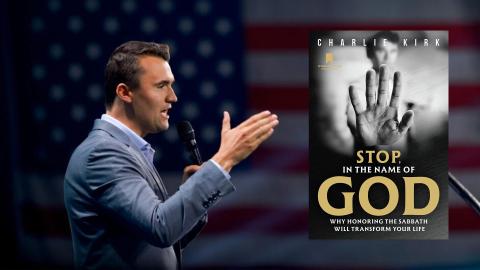
Charlie Kirk’s final book, titled Stop in the Name of God, reflects his profound journey toward understanding the significance of the Sabbath. Published posthumously, the book captures Kirk’s insights on rest and spirituality, emphasizing the transformative power of taking a break from the demands of modern life.
Pastor Rob McCoy, a close friend and spiritual advisor, shared that Kirk was enthusiastic about the book’s publication. He recalled a pivotal moment in Korea when Kirk finalized the manuscript, noting that it had a lasting impact on him. “It changed him in a profound way,” McCoy remarked, underscoring the book’s importance in Kirk’s life.
Kirk often expressed that his most cherished experience was visiting Israel. During this trip, he learned about the Sabbath, or Shabbat, a practice deeply rooted in Jewish tradition. McCoy highlighted that Kirk faced a crisis due to his hectic lifestyle, which led him to seek counsel from his colleague, Dave Engelhart, a member of the board at Turning Point USA. Engelhart suggested Kirk consider observing a Sabbath, prompting him to explore its spiritual significance.
According to Micha’el Ben-David, a Messianic Jew from the Galilee, “Shabbat is the Kingdom of Heaven’s deepest secret that’s been hidden in plain sight.” He emphasized that keeping the Sabbath holy is not just a commandment but a way to connect with God. In Israel, the Sabbath begins at sundown on Friday and continues until sundown on Saturday, during which many families engage in rituals like lighting candles and blessing bread and wine.
Kirk’s exploration of the Sabbath led him to recognize its importance in his life. McCoy noted that Kirk’s realization was that “Sabbath is for man, not man for the Sabbath.” This perspective transformed Kirk’s approach to rest, allowing him to prioritize family time and spiritual connection. “He would just turn off his phone, be with his family,” McCoy explained, highlighting how Kirk sought to combat the overwhelming nature of a busy life.
Ben-David elaborated on the Sabbath experience, sharing that it involves a series of blessings and prayers, emphasizing the importance of honoring loved ones. “It’s a time to honor her,” he said, referring to the traditional blessings for wives, encapsulating the spirit of family unity during this sacred time.
In Israel, Shabbat is characterized by rest and reflection. Activities such as driving, working, and using electronics are typically avoided. Ben-David remarked, “God has given us a blueprint… if we follow it, we will enter that rest.” He referenced Hebrews 4:12, stating, “There still remains a rest for the people of God,” illustrating the biblical foundation for this practice.
Despite the lessons he learned, Pastor McCoy observed that Kirk struggled to find rest amidst his busy schedule. He was constantly traveling, hosting programs, and responding to numerous messages. After the Kirks began observing the Sabbath, McCoy noted a significant change in Kirk’s well-being. Kirk began to see the Sabbath as a vital element of his health and relationship with God.
Kirk’s reflections on the Sabbath resonate with a broader audience. In a podcast before his passing, he advised listeners feeling overwhelmed to disconnect from technology for one day, suggesting that such a break could significantly improve mental health. “If you are feeling overrun by society… turn your phone off for one day,” he urged.
McCoy summarized Kirk’s journey, stating that the insights gained from his study of the Sabbath inspired him to write Stop in the Name of God. He described it as Kirk’s “magnum opus,” encapsulating his understanding of spirituality and the necessity of rest in a chaotic world.
This book serves not only as a tribute to Kirk’s life but also as a reminder of the importance of stepping back, reflecting, and reconnecting with what truly matters.