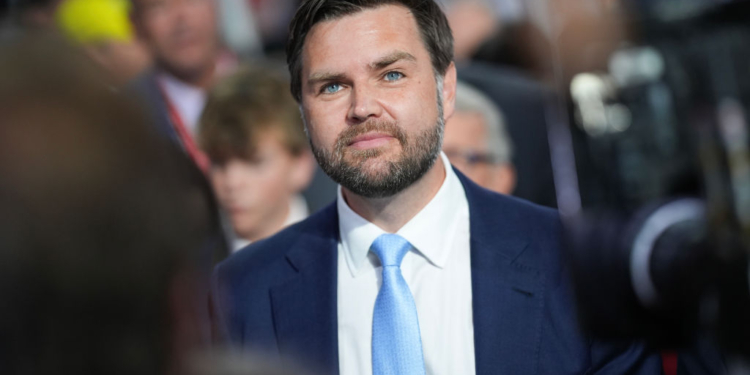
UPDATE: A new Yale youth poll reveals that if the presidential election were held tomorrow, Vice President JD Vance would emerge as the Republican frontrunner, while California Governor Gavin Newsom leads the Democratic field. The poll indicates Vance holds a commanding 51% support among registered voters, significantly ahead of Donald Trump Jr. by 43 points and Florida Governor Ron DeSantis, who trails at 6%.
This urgent update from the Yale Youth Poll, conducted between October 29 and November 11, 2025, surveyed 3,426 registered voters, including 1,706 individuals aged 18-34. The results underscore a pivotal moment in the 2028 election landscape.
Reports show that while only 20% of voters aged 18-22 and 28% of those aged 23-29 support Trump in a potential GOP primary, a majority of respondents over 45 favor him for a hypothetical third term. In this scenario, Trump leads with 50%, followed by Vance at 19% and other candidates at 5%.
On the Democratic side, Newsom stands out with 25% support. Former Vice President Kamala Harris, Rep. Alexandria Ocasio-Cortez, and former Transportation Secretary Pete Buttigieg follow closely with 18%, 16%, and 14%, respectively. The analysis highlights that younger and older Democrats largely agree on the most electable candidates, with Ocasio-Cortez leading among Democrats under 35 at 32%.
The poll also reveals that Democrats overwhelmingly view Newsom as their best chance against a generic Republican, with 85% believing he is most likely to win in the general election.
“Unlike in the Republican primary, the Democratic candidates have larger variations in support between different demographic groups, suggesting that candidates have started to develop bases of support,”
according to the poll analysis.
Marco Rubio recently stated that Vance is the GOP front-runner for the upcoming election, confirming the shifting dynamics within the party.
As the election landscape rapidly evolves, these findings signal crucial implications for both parties heading into 2028. Voters and political analysts alike are urged to watch how these trends develop in the coming months, especially as the primaries approach.
This developing story reveals significant insights into voter preferences and party dynamics that could shape the future of American politics. Share your thoughts on these findings and how they may influence the upcoming election!