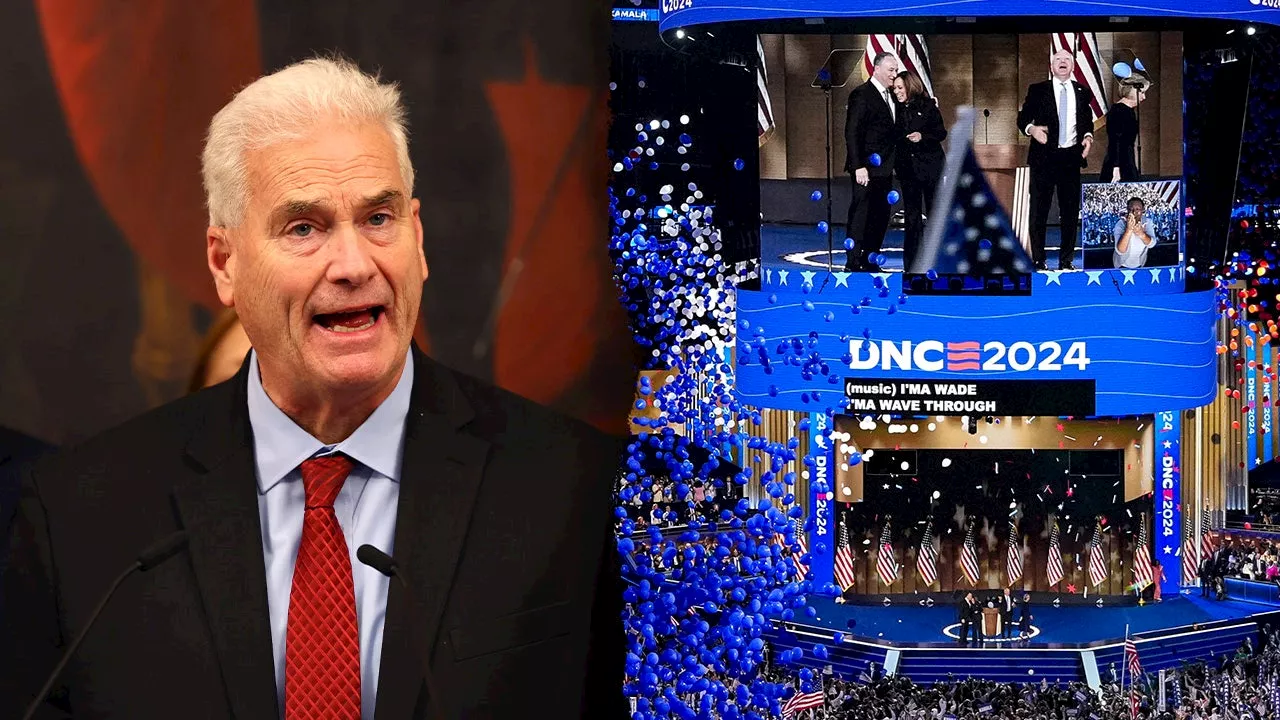
BREAKING: House Majority Whip Tom Emmer has launched a fierce attack on Democratic lawmakers, accusing them of blatant hypocrisy regarding the SAVE America Act, which mandates photo identification for federal voting. This accusation comes in the wake of nearly all Democrats voting against the bill last week, which aims to enhance election integrity.
Emmer’s comments highlight an urgent contradiction: while Democrats decry voter ID laws as oppressive, they require photo IDs for events such as the recent Democratic National Convention where Vice President Kamala Harris was nominated. “If they think it’s voter suppression, why do they require photo IDs at the DNC?” Emmer stated. “Americans are smarter than they give them credit for,” he added, emphasizing the double standards in voter ID discussions.
The SAVE America Act passed the House recently with unanimous support from Republicans and one Democrat, Rep. Henry Cuellar of Texas. This legislation not only mandates federally accepted photo IDs but also reinforces proof-of-citizenship requirements. The bill reflects a growing trend in U.S. elections, as public opinion strongly favors voter ID laws.
A Pew Research Center poll from August 2025 revealed that an overwhelming 83% of Americans support government-issued photo IDs for voting, with only 16% opposed. This sentiment mirrors findings from a Gallup poll conducted in October 2024, where 84% of respondents backed the necessity of such IDs in federal elections.
“These guys are doing the same old broken record about voter suppression,” Emmer told Fox News Digital.
Democratic leaders, including House Minority Leader Hakeem Jeffries and Senate Minority Leader Chuck Schumer, have dismissed the bill, labeling it a form of “voter suppression” and likening it to “a modern-day Jim Crow.” Jeffries raised concerns over provisions that could lead to the Department of Homeland Security investigating illegal immigrants on voter rolls.
The urgency of this legislation reflects broader national conversations surrounding election integrity and voter access. Emmer’s accusations aim to shift the narrative, emphasizing that if photo IDs are acceptable in various aspects of public life, their use in voting should not be controversial.
As the political landscape continues to evolve, the focus will now shift to how this bill will impact future elections and voter turnout across the nation. Stay tuned for more updates on this developing story.