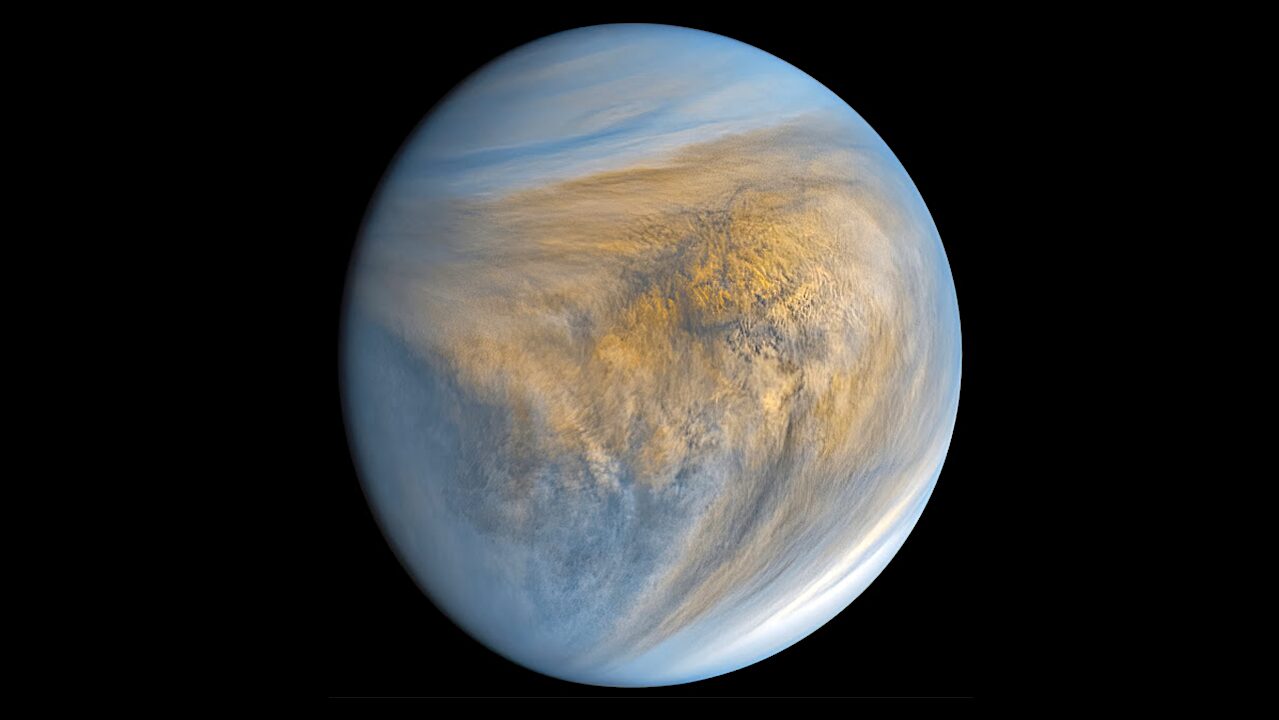
Recent research has shed light on the rotational dynamics of Venus, offering valuable insights into the potential behaviors of exoplanets situated in the habitable zones of solar-type stars. The study, led by astrophysicist Sylvio Ferraz-Mello, revisits Venus’s unique retrograde rotation to understand how dense atmospheres can significantly influence planetary rotation over time.
The research indicates that planets within the habitable zone (HZ) often develop thick atmospheres, which can affect their rotational characteristics. Over extended periods, these planets may gravitate toward stationary solutions, which can manifest as synchronous or asynchronous rotations. The findings from this study, presented at the XIII Taller de Ciencias Planetarias in Montevideo on December 6, 2025, utilize the creep tide theory to analyze gravitational tidal torque and its implications.
Utilizing mathematical analysis, researchers explored the differential equations that arise from the combined effects of tidal and atmospheric torques. The results suggest that a dense atmosphere could transform the primordial rotation of a planet, potentially leading to a gradual reversal of its rotational direction. Venus serves as a prime example of this phenomenon, where its retrograde rotation has intrigued scientists for decades.
In examining the changes in Venus’s rotational elements, the study highlights variations before and after its rotation reversal. Notably, the research outlines how factors like obliquity and equinox positions can shift significantly due to atmospheric influences. The findings provide a clearer understanding of the dynamics at play and emphasize the importance of considering atmospheric conditions when studying exoplanets.
This investigation not only contributes to the understanding of planetary rotations but also raises questions about the evolutionary paths of exoplanets in the HZ. As scientists continue to explore these celestial bodies, the insights gained from Venus may inform future research and mission planning in astrobiology and planetary science.
The complete study can be found in the Earth and Planetary Astrophysics section under the reference arXiv:2512.06526. Researchers and enthusiasts alike will find the implications of this work critical as they seek to unravel the complexities of planetary systems beyond our own.