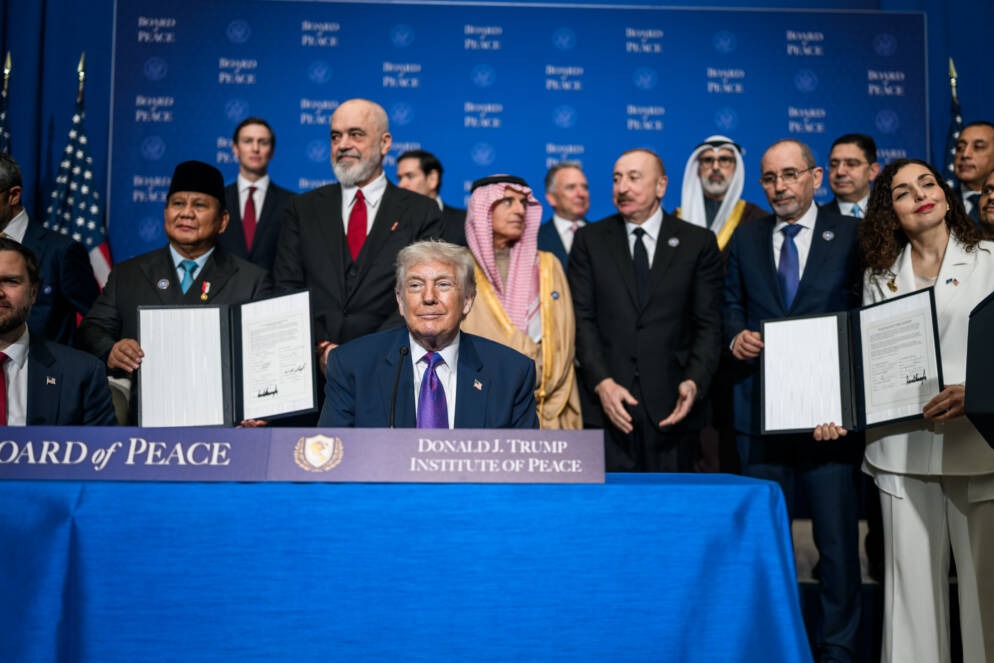
UPDATE: President Donald Trump has officially launched the Board of Peace during a high-stakes ceremony in Washington, D.C. on February 19, 2026. This unprecedented meeting, attended by nearly 50 countries, aims to reshape the landscape of peace-building efforts in the Middle East by tying financial aid directly to political reforms.
The United States has pledged a staggering $10 billion towards the reconstruction of Gaza, with additional billions expected from other nations. This ambitious initiative is set to be managed by the World Bank through a newly established Gaza Reconstruction and Development Fund, designed to provide oversight and ensure donor confidence. However, the U.S. commitment hinges on future congressional approvals, meaning immediate funding remains uncertain.
This initiative comes on the heels of three years of intense conflict and a fragile cease-fire. The Board of Peace’s strategy is clear: financial aid will be contingent upon Hamas disarming and a transition to a non-Hamas Palestinian government. This transactional approach marks a significant shift from traditional aid methods, focusing on outcomes rather than goodwill.
In stark contrast to previous donor conferences, which often made grand pledges without enforcement mechanisms, the Board of Peace insists on strict conditions for aid distribution.
“No gun forfeiture, no money distributed,”
stated a senior Israeli official, emphasizing the urgency for Hamas to comply. Palestinian leaders have expressed concerns about weak institutions in Gaza, highlighting the challenges this model may face in practical application.
The Board, chaired by Trump with an unusual lifetime tenure, proposes a governance structure that consolidates political authority and enforces financial compliance. Countries pledging over $1 billion are offered lifetime membership, a move that has garnered mixed reactions. Some European nations have opted out, questioning the governance and legitimacy of the Board.
Trump’s vision extends beyond Gaza, suggesting that this model could potentially rival the United Nations. The immediate goal is a demilitarized Gaza governed by a new Palestinian body and supported by international funding. However, the success of this plan rests on the Board’s ability to build credibility and achieve lasting peace.
As the world watches, the implications of the Board of Peace are profound, potentially redefining international aid and conflict resolution strategies. The clock is ticking for Hamas to comply, and the coming weeks will be critical in determining whether this ambitious plan can transition from lofty ideals to tangible outcomes.
Stay tuned for more updates on this developing story as the international community reacts and the Board of Peace moves forward with its agenda.