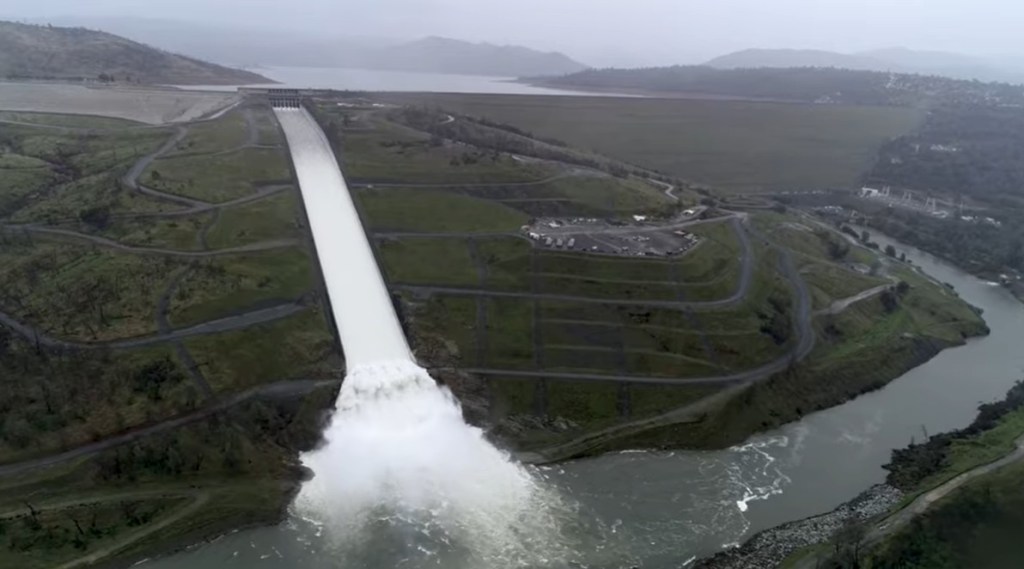
UPDATE: Operators at Oroville Dam in California have just announced the opening of spillway gates, releasing billions of gallons of water into the Feather River. This critical move comes as the reservoir has surged dramatically due to a series of powerful storms, posing flood risks to surrounding areas.
In the past three weeks, the Oroville Reservoir has received a staggering 12 inches of rain, leading to an alarming 75-foot increase in water levels. The reservoir, which is crucial for California’s water supply, has jumped from 51% to 75% full, now holding over 2.5 million acre feet of water—an increase of 837,554 acre feet or approximately 273 billion gallons. This volume is enough to fill 400,000 Olympic swimming pools and could provide water for 4.2 million people for an entire year.
At approximately 6 a.m. on Monday, December 18, 2023, engineers from the California Department of Water Resources opened the gates to manage reservoir levels and prevent overflow. This decision is vital for maintaining safety downstream, as uncontrolled spills can lead to catastrophic flooding. The flow rate increased nearly tenfold, from 1,856 cubic feet per second on Christmas Day to an astounding 16,135 cubic feet per second on Monday.
Despite these efforts, the reservoir continues to rise by about 3 feet per day, as inflow rates remain double that of the outflow. “When a raindrop hits the ground, it takes time to reach the reservoir,” explained Jeffrey Mount, a professor emeritus at UC Davis. “High flows can persist for days after a storm event.”
Currently, the reservoir is at 136% of its historical average for this time of year. Following two dry days, DWR has reduced outflow to 12,842 cubic feet per second, but with forecasts predicting at least 10 days of sunny weather, further reductions are expected.
Oroville Dam is not just a reservoir; it is a critical barometer for California’s water management during both droughts and deluges. In years of ample rainfall, like this one, the dam is filled and water is released to rejuvenate rivers and support local ecosystems. However, during dry spells, it often serves as a stark reminder of water scarcity, having reached its lowest level of just 22% in August 2022.
The dam’s history is also punctuated by notable events, including the infamous spillway collapse in 2017, which led to the evacuation of 188,000 residents and prompted a $1 billion reconstruction project. As the current winter season begins, water experts are hopeful for more storms in February and March to further replenish the state’s reservoirs and snowpack, vital for California’s long-term water supply.
With Oroville Dam’s situation developing rapidly, residents and stakeholders across the state are closely monitoring the situation. The careful balancing act of managing water levels is crucial in ensuring safety and sustainability in this vital water resource.