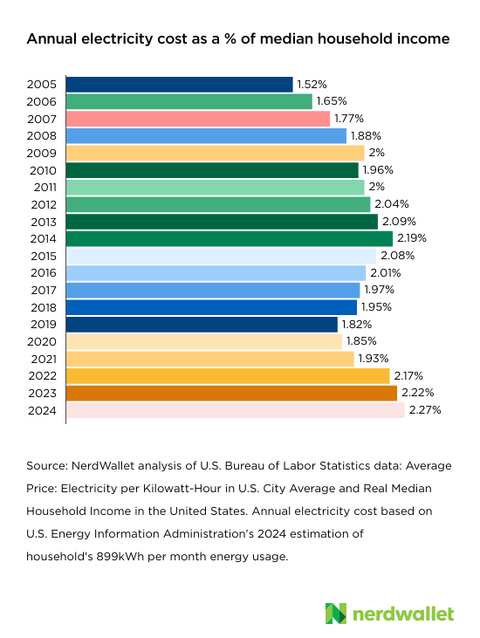
UPDATE: Electricity prices across the U.S. are soaring, with residential costs up a staggering 10.5% from January to August 2023, according to the National Energy Assistance Directors Association (NEADA). This increase comes just as households prepare for the winter season, amplifying financial strain on families nationwide.
The rise in electricity prices is not uniform; while three states reported decreases, nine states experienced hikes exceeding 20%, with Missouri leading at 37.4% and North Dakota at 30.3%. Another 19 states also saw increases between 10% and 20%. As energy costs escalate, the likelihood of stabilizing prices soon appears slim, making energy affordability a pressing political issue.
Utilities authorized $34 billion in rate hikes in just the first nine months of 2023, a dramatic increase from $16 billion during the same period last year, as reported by Powerlines, a nonprofit focusing on energy regulation.
“Our poles and wires are aging… it costs a lot of money to just replace that infrastructure,”
stated Charles Hua, founder and executive director of Powerlines, highlighting the critical challenges facing the energy sector.
The surge in electricity costs can be attributed to three major factors:
1. **Aging Power Infrastructure:** The current grid’s outdated components necessitate costly replacements, contributing significantly to rising bills. Utilities are incentivized to expand infrastructure rather than improve existing systems, pushing costs onto consumers.
2. **Extreme Weather Events:** Increasingly severe weather, including storms and heatwaves, has damaged energy infrastructure and escalated repair costs. Utility companies are now required to not just replace but upgrade systems to withstand more frequent disruptions.
3. **Rising Fuel Costs:** Natural gas, which accounts for approximately 43% of U.S. electricity generation, has seen fluctuating prices due to geopolitical tensions, particularly following Russia’s invasion of Ukraine. These rising costs often get passed directly onto customers, further inflating bills.
For many households, the impact is dire. The average monthly electric bill has jumped from $121 in 2021 to an estimated $156 in 2025, according to NEADA. This increase may seem small, but it’s enough to push vulnerable families into financial distress. In Pennsylvania, power shutoffs have surged by 21% this year, affecting 270,000 homes.
Political leaders are responding to these alarming trends. In New Jersey’s gubernatorial race, energy affordability became a key campaign issue, with candidates emphasizing the need for immediate action against rising costs.
“I do think that in the next three months this will be just a big issue,”
Hua warned, suggesting that the convergence of rising costs and political pressure could ignite significant changes in energy policy.
Despite these challenges, there is hope for improvement. Hua expressed optimism that heightened awareness of energy affordability could prompt regulators to make existing infrastructure more efficient. Currently, the grid operates at only 40% to 50% efficiency, with technologies available that could increase this to 60% to 70% at a lower cost than new construction.
What can consumers do? While shopping for electricity providers is not an option due to utility monopolies, homeowners can enhance their energy efficiency. For those struggling financially, assistance programs like the Low Income Home Energy Assistance Program (LIHEAP) are available, with recently released federal funds to help ease the burden.
As winter approaches and electricity costs continue to rise, the urgency surrounding this issue remains critical. The intersection of economic strain and energy policy will likely dominate discussions in the coming months, making it essential for consumers to stay informed and engaged in advocacy for affordable energy solutions.