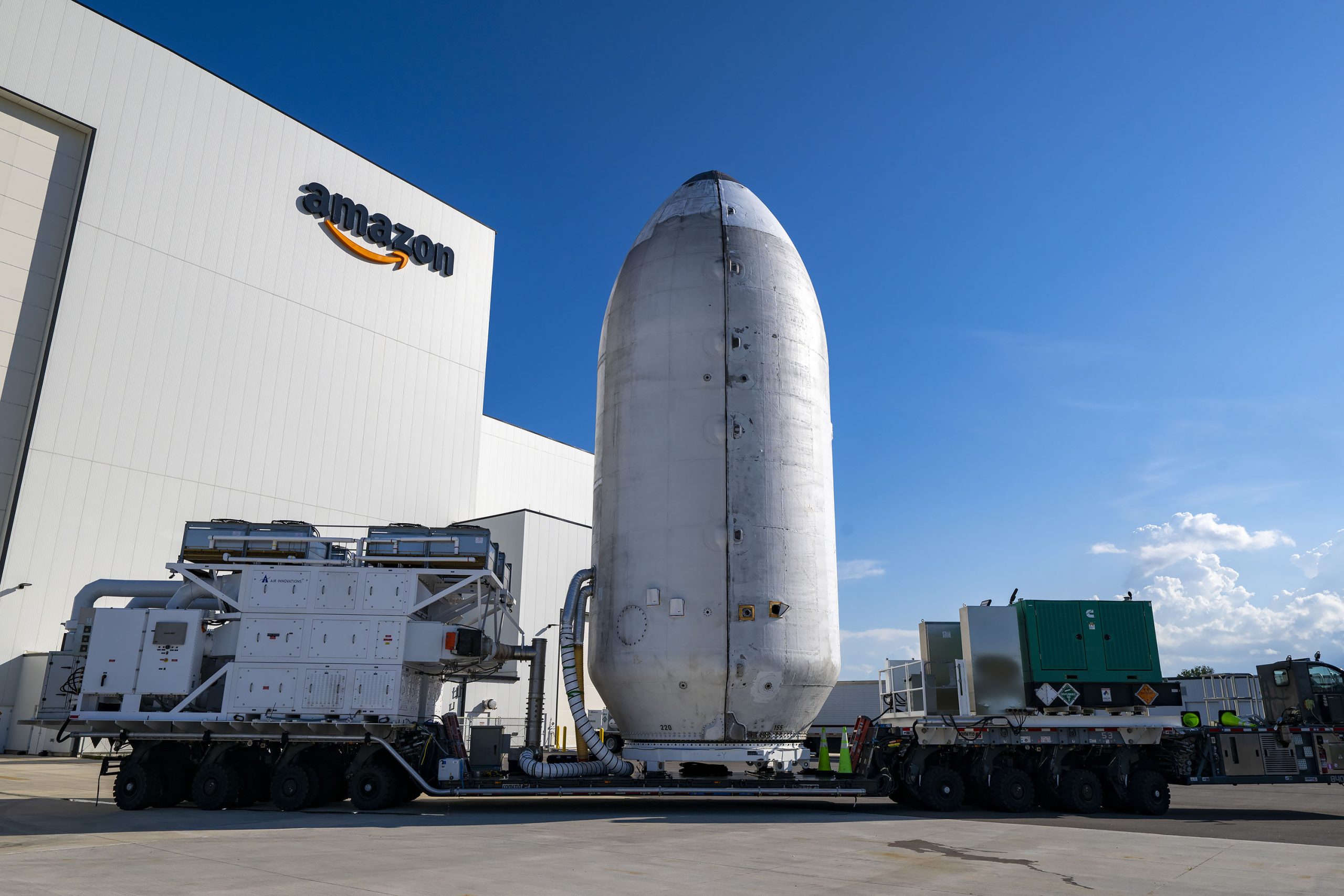
Blue Origin, the aerospace company founded by Jeff Bezos, has announced its ambitious plans to enter the competitive field of global broadband from low Earth orbit (LEO) with a new satellite network named TeraWave. In a regulatory filing that surprised many industry stakeholders, Blue Origin revealed intentions to deploy more than 5,000 LEO satellites, complemented by a medium Earth orbit (MEO) layer capable of delivering up to 6 terabits per second in point-to-point ground links.
This initiative marks a significant shift for Blue Origin, which has primarily focused on launching rockets and developing lunar landers, as well as the Blue Ring in-space mobility vehicle platform. The TeraWave program raises immediate concerns regarding the readiness of launch capacity and technology, as it seeks to compete in a market already dominated by established players.
The proposed LEO satellites will utilize higher-frequency spectrum bands, making them more vulnerable to atmospheric interference compared to existing competitors. The promised high speeds from the MEO layer will depend on emerging optical space-to-ground technology, which has yet to be widely tested.
Industry Reaction and Competitive Landscape
Industry experts are viewing TeraWave as a potential long-term competitor rather than an immediate threat. Armand Musey, founder of advisory firm Summit Ridge Group, expressed skepticism about the feasibility of TeraWave, citing the slow rollout of Amazon’s own LEO broadband constellation, which currently includes 3,232 satellites. He noted, “There aren’t enough launch vehicles. There are not even enough launch vehicles to get Amazon Leo launched on schedule.”
In response, Blue Origin maintains that it plans to utilize its fleet of New Glenn rockets for the TeraWave constellation. Stephanie Plucinsky, a spokesperson for Blue Origin, emphasized that the company is committed to bringing TeraWave to fruition, stating, “We plan to fly the TeraWave constellation on our fleet of New Glenn rockets.”
The FCC application submitted on January 21, 2026, outlines a network of 5,280 LEO satellites operating in Q- and V-bands. These satellites will be connected to 128 spacecraft in MEO, which in turn will link to optical ground terminals capable of achieving symmetrical upload and download speeds of up to 6 Tbps.
Strategic Positioning and Market Implications
Distinct from consumer-focused networks, TeraWave aims to cater to enterprise-grade internet access, offering higher speeds, increased redundancy, and rapid scalability for government and commercial clients. The service will be limited to approximately 100,000 enterprise and government customer sites globally to prevent network congestion. This approach sets TeraWave apart from other broadband systems that typically share capacity among numerous users.
Plucinsky clarified that TeraWave will not compete directly with Amazon Leo, asserting that the initiative responds to a recognized market need for dedicated internet services. This strategic positioning places Blue Origin in competition with other notable players such as Telesat and SES, both of which are also targeting enterprise users and government contracts.
Analysts suggest that Blue Origin’s entry into the LEO broadband market is validating the viability of MEO connectivity. Carmel Ortiz, senior vice president of MEO constellation programs at SES, remarked, “We’ve known for some time that it’s a great orbit and we’ve been able to be successful in that orbit.”
Despite the ambitious goals, TeraWave faces significant technical challenges. The reliance on high frequencies and optical links for achieving the desired data rates introduces risks, particularly regarding atmospheric disruptions and the current lack of user terminal infrastructure for these bands.
Experts like Jean-Baptiste Thépaud from Novaspace highlighted that Blue Origin’s design choices, while innovative, may encounter hurdles related to reliability and operational scalability. The challenges are compounded by the ongoing complexity of regulatory approvals, which are crucial for launch timelines.
Blue Origin aims to commence launches within 18 months, a timeline that relies heavily on navigating regulatory landscapes and securing necessary launch capacity. The company’s FCC filing includes multiple waiver requests and seeks to redefine how competing satellite applications are reviewed.
As the LEO broadband market continues to evolve, the introduction of TeraWave could reshape competitive dynamics, especially as established players like OneWeb and Amazon ramp up their own satellite deployments. Analysts are closely monitoring how TeraWave will impact the broader market landscape, particularly for enterprise-grade connectivity.
The announcement of TeraWave underscores the burgeoning demand for high-capacity satellite solutions, particularly as industries increasingly rely on cloud services and real-time data transfer. With expectations of significant growth in the sector, Blue Origin’s plans could pave the way for new developments in satellite communications and further disrupt existing market structures.
As Blue Origin navigates the complexities of the satellite launch industry, its progress will be closely watched by competitors and investors alike, as the race for LEO broadband intensifies.