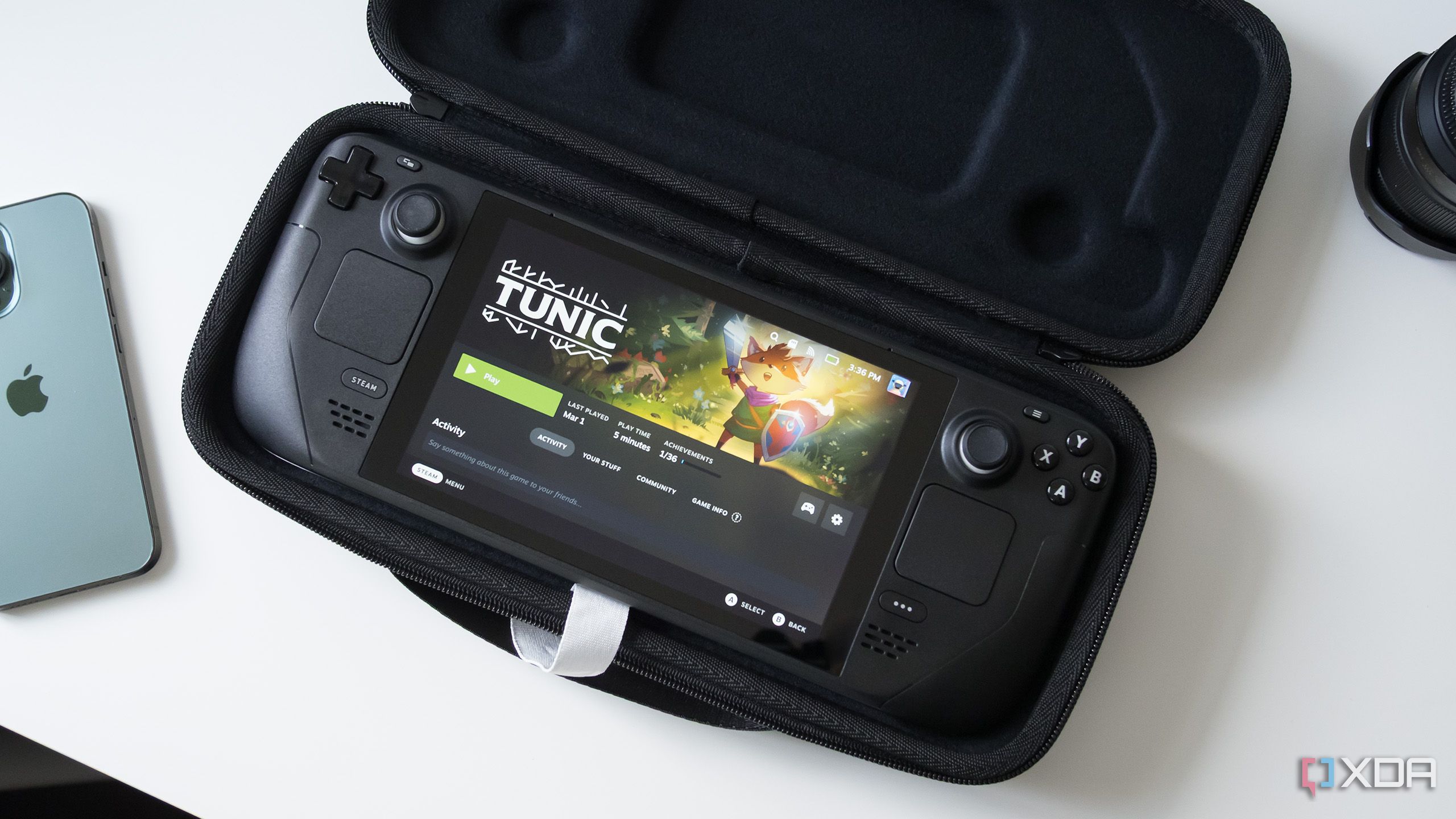
The Steam Deck has emerged as a powerful gaming device, effectively fulfilling many of the promises associated with Valve’s upcoming Steam Machine. Since its launch in 2022, the Steam Deck has provided users with the flexibility to enjoy gaming on large screens, the convenience of compact PC gaming, and the ability to install various applications without the need for proprietary hardware. As a result, many users are discovering innovative ways to utilize the Steam Deck as both a handheld console and a portable PC.
Transforming the Living Room Experience
The Steam Deck serves as a compact and powerful PC that fits seamlessly under a television. Users can connect the device to their TV using a standard multi-port USB-C hub, which facilitates an HDMI connection. This setup mirrors the Steam Deck’s interface on the big screen, offering an experience akin to dedicated living room consoles, such as the Nintendo Switch. While direct connections via USB-C to HDMI are possible, they can lead to battery drain, as the device struggles to power the APU while pushing high-resolution signals. A USB-C hub mitigates this issue by providing power passthrough at a modest cost.
For an enhanced gaming experience, users can connect a variety of game controllers, such as the Xbox One Elite Controller, via Bluetooth. The Steam Deck supports FidelityFX Super Resolution (FSR), allowing it to output sharp, upscaled images on 4K displays. This feature is particularly beneficial for video playback or game streaming services like GeForce Now.
Steam Deck as a Portable Productivity Tool
Valve’s marketing emphasizes the Steam Machine as a mini-PC for those on the go. However, the Steam Deck offers a unique advantage: it remains functional even when disconnected from a power source. This capability means that users can repurpose the device into a versatile PC with minimal additional equipment. A portable USB-C monitor, combined with a spare keyboard and mouse, transforms the Steam Deck into a powerful workstation.
Equipped with a custom AMD APU built on Zen 2 architecture and RDNA 2 graphics, along with 16 GB of LPDDR5 memory, the Steam Deck is capable of handling a wide range of productivity tasks. Its compact design allows it to fit easily in a backpack, making it suitable for travel or work in various environments, such as airports or coffee shops.
Users can run applications like Obsidian for note-taking and browse the internet with multiple tabs open without any significant performance issues. The Nested Desktop feature further enhances usability by allowing seamless transitions between gaming and work without the need for rebooting.
The software capabilities of the Steam Deck further distinguish it from the Steam Machine. Valve has designed the Steam Deck as an open platform, granting users the freedom to install third-party applications or alternate operating systems. Since its launch, the Steam Deck has operated on this principle, offering full access to the Linux desktop. This allows users to download productivity apps, web browsers, and creative tools via Flatpak support through the Discover software center. For those looking for even more functionality, Microsoft Windows can also be installed, and the hardware is robust enough to support it without major compromises.
While the Steam Machine does offer superior hardware that can handle more demanding workloads and deliver better frame rates, the Steam Deck fulfills many of the same promises. For most users, it provides everything the Steam Machine aims to deliver, all while maintaining portability and a competitive price point.
As the gaming landscape continues to evolve, the Steam Deck stands out as a versatile device that caters to a wide range of users, from casual gamers to productivity-focused individuals. Its ability to seamlessly transition between gaming and work is a testament to its design and functionality, making it a formidable player in both the gaming and tech markets.