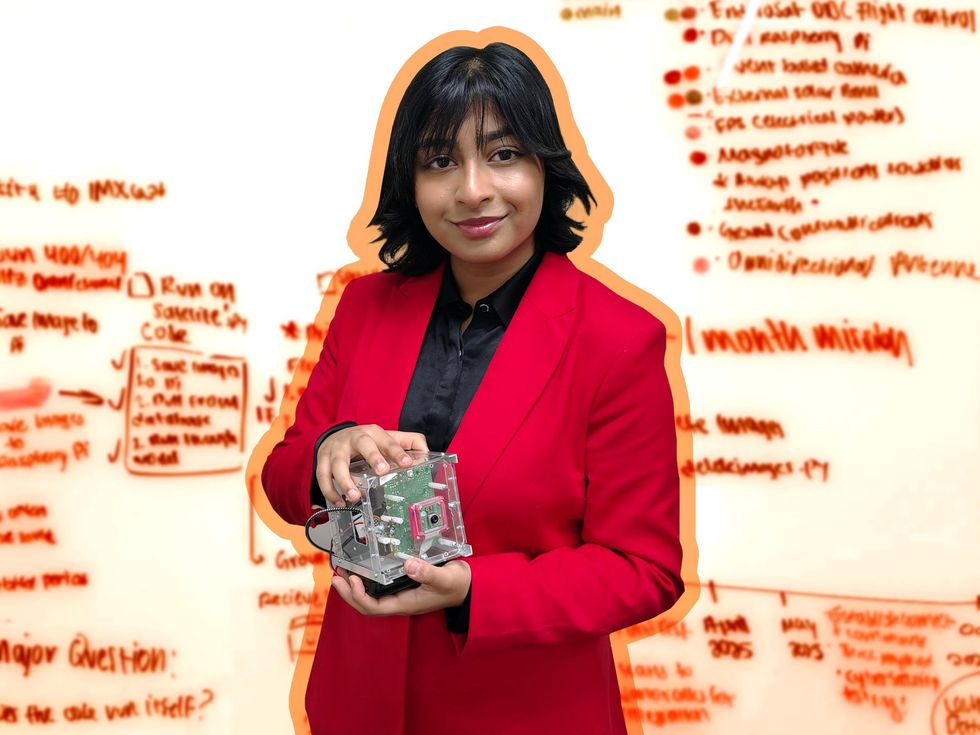
High school sophomore Abigail Merchant, from Orlando, Florida, has developed an innovative CubeSat designed to detect flooding more effectively. At just 15 years old, Merchant is addressing a critical issue in her state, which frequently faces floods exacerbated by climate change. The U.S. Environmental Protection Agency notes that warmer air leads to increased rainfall, heightening the risk of flooding.
Currently, existing technology, including satellites, synthetic aperture radar, and GPS, is used to gather data on flood events. However, Merchant highlights that these systems often have slow data transmission speeds, resulting in delayed responses in emergencies. With flooding on the rise globally, there is an urgent need for more reliable methods for data collection and rapid response.
Merchant’s solution is a small, cost-effective CubeSat integrated with artificial intelligence. This satellite, which utilizes modular components measuring 10 by 10 by 10 centimeters, is designed to be both agile and scalable. The CubeSat captures high-definition images of affected areas and applies pattern recognition techniques to assess infrastructure damage and locate survivors.
Engineering Inspiration and Development
Merchant’s interest in enhancing disaster response began after she learned that emergency workers often wait hours for satellite data during critical situations. This motivated her to explore the capabilities of CubeSats, known for their ability to operate in constellations and provide near real-time updates.
Last year, Merchant and three classmates participated in the MIT Beaver Works Build a CubeSat Challenge. Their team, named Satellite Sentinels, developed a CubeSat powered by a convolutional neural network (CNN) to identify flood-prone areas and gather data for disaster relief and environmental monitoring. Merchant served as the group’s payload programmer and led mission design efforts, which included hardware configuration and the development of autonomous software.
The team created a 3D model of their CubeSat to optimize component placement and designed the device using a Raspberry Pi, sensors, and a camera. The project cost approximately USD 310 to build and weighs around 495 grams. During tests, the CubeSat successfully transmitted images to a laptop, where Merchant’s machine learning algorithm analyzed changes in water color and pixel density to detect flooding.
“While many existing systems operate on multihour cycles, the CubeSat captures high-resolution images every 2 minutes,” Merchant explained. “This system can trigger alerts delivered to first responders via SMS or email.”
To validate their system, Merchant and her team created a flood simulation using a Lego city model in a bathtub. After adding water, the CubeSat successfully detected the simulated flood and transmitted images back to the laptop. The Satellite Sentinels placed third out of 30 teams.
Continuing Research and Future Goals
Merchant is now furthering her research on flood-prevention technologies at Accenture in Richmond, Virginia, where she works remotely as a payload owner and designer for the company’s CubeSat launch team. Following her experience at MIT, she reached out to her former mentor, Chris Hudson, who offered her an internship. She is focused on transitioning her project from prototype to a functional product while addressing challenges encountered during the MIT project, particularly the CNN’s difficulty in detecting flooding under variable conditions.
“Without context, the model can misinterpret complex visual cues,” she noted, explaining that she is training the algorithm to recognize flooding by analyzing individual pixel colors. Additionally, she suggested using SubMiniature Version A (SMA) antennas for improved connectivity, essential for satellites operating at high altitudes.
Merchant’s work has been transformative for her career. “The development process has been one of the most formative experiences of my career so far,” she remarked, expressing excitement about the knowledge she has gained.
Currently, her payload is scheduled for launch in early 2024. Merchant is also interning at the MIT Computer Science and Artificial Intelligence Laboratory, where she is exploring cognitive cartography to structure complex information into semantic maps.
As a young researcher, Merchant recognizes the significance of her involvement with the Institute of Electrical and Electronics Engineers (IEEE). She was introduced to the organization by Joe Jusai, a former finance chair of the IEEE Orlando Section, and she became actively engaged while working on a science fair project involving a robotic arm.
Her experience at IEEE events has been pivotal, culminating in a presentation of her CubeSat project at the IEEE SouthEastCon. “It’s one of those experiences that really changes you,” she stated, expressing her enthusiasm for potentially becoming an IEEE student member in the future.
Merchant aspires to study at MIT or Stanford and is motivated by the possibility of one day becoming the president of IEEE, following in the footsteps of leaders she admires. Her journey reflects a commitment to harnessing technology for social good, with the potential to save lives through improved flood detection.