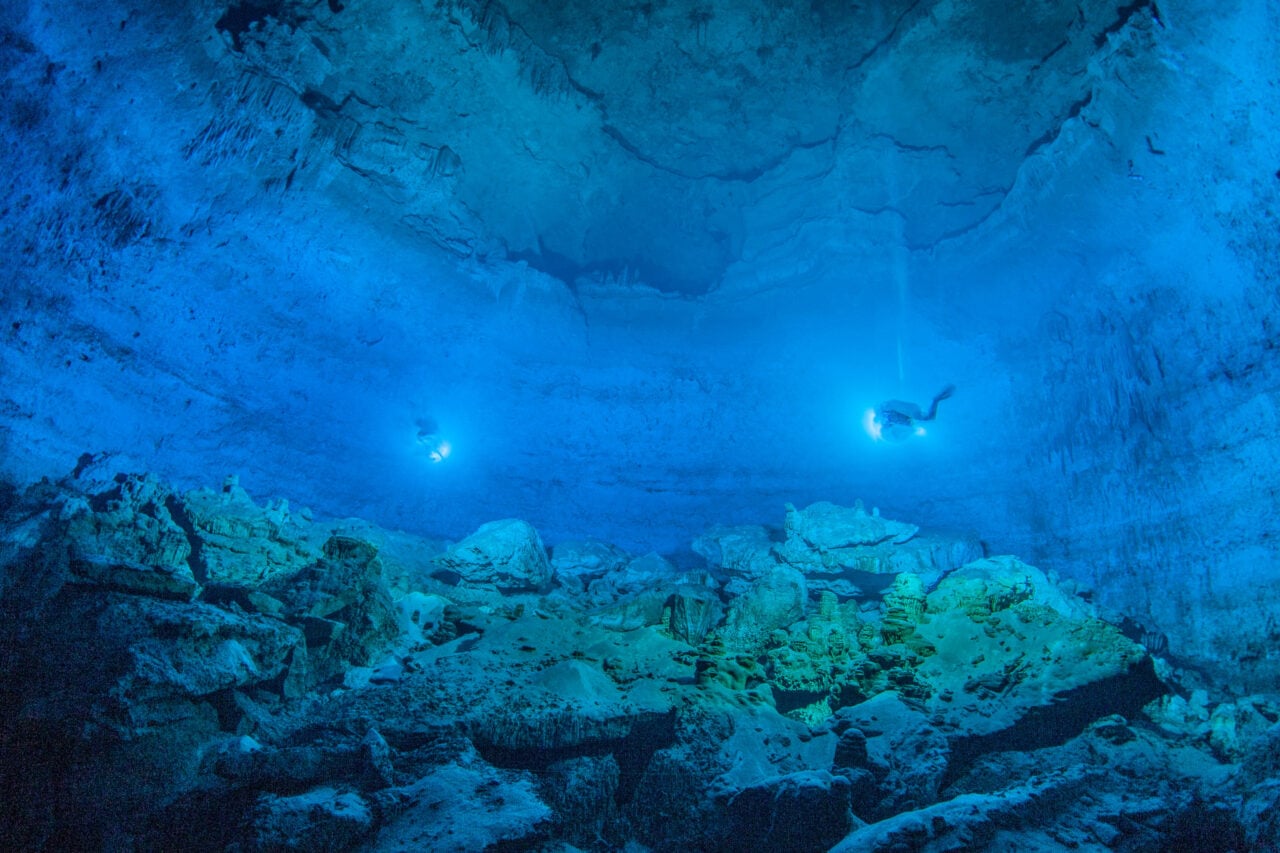
Deep beneath the tropical forests of the Yucatán Peninsula, a submerged cave system known as Hoyo Negro has unveiled remarkable evidence of life during the Ice Age. This underwater archaeological site, part of the larger Sac Actun system in Mexico’s Quintana Roo state, has provided crucial insights into the habits of early humans and extinct animals that roamed the region thousands of years ago.
Hoyo Negro, a massive bell-shaped pit, became famous in 2014 when it was discovered to house numerous fossils, including those of Naia, one of the oldest human skeletons found in the Americas. Discovered in 2007 by divers Alejandro Alvarez, Franco Attolini, and Alberto Nava Blank, this site has since drawn the attention of international scientists. The National Institute of Anthropology and History (INAH) in Mexico initiated the Hoyo Negro Underwater Archaeological Project to study the site, involving a diverse team of researchers and divers.
Exploration and Discovery
Since 2011, Roberto Chávez Arce, a co-director of the project, has explored the intricate tunnels of Sac Actun. His captivating underwater photography has allowed scientists to understand the cave’s structure and contents. Diving in these unexplored tunnels is fraught with danger due to their darkness and unpredictability. Divers must carry extensive safety equipment, including breathing apparatus and navigational tools, to prevent getting lost.
Initially, accessing Hoyo Negro required a lengthy swim of about 914 meters from a cenote entrance. Recent advancements have improved access significantly, with the discovery of a new cenote just 76 to 91 meters from the pit and the use of motorized scooters for faster underwater travel.
Mapping the cave system has evolved from using simple tools like compasses and tape measures to advanced structure-from-motion (SfM) photogrammetry. This method generates 3D models from overlapping photographs, revealing the vast dimensions of Hoyo Negro, which spans over 61 meters in depth and has a diameter of more than 61 meters at its base.
Insights from the Ice Age
Research conducted on sediment cores and ancient deposits indicates that Hoyo Negro was accessible and dry during various periods of the Late Pleistocene, around 9,850 years ago. The water level fluctuated in line with rising sea levels, ultimately flooding the cave system around 6,000 years ago. During its dry periods, the cave offered vital resources, including drinking water, which would have attracted both animals and early humans.
The remains of Naia, dated to approximately 12,970 to 12,770 years ago, provide a poignant look into the life of early inhabitants. As the most complete skeleton from this era, Naia was likely a young female who suffered a fatal injury after falling into the pit. Analysis of her bones suggests she faced nutritional challenges and lived in a time when the environment was markedly different from today’s lush jungles.
In addition to human remains, Hoyo Negro has yielded fossils of various extinct mammals, including the short-faced bear and ground sloths, as well as evidence of human activity such as ochre mining. The presence of these animals indicates that the cave served as an important habitat during the Pleistocene.
The discovery of a new genus and species of ground sloth named Nohochichak xibalbahkah further emphasizes the significance of Hoyo Negro. This species, along with fossils of gomphotheres—extinct elephant-like creatures—adds layers to our understanding of the Great American Biotic Interchange and the migrations of species across continents.
Researchers continue to investigate the implications of their findings, with ongoing studies planned to explore the ancient ecosystems of the Yucatán. The work conducted at Hoyo Negro demonstrates the importance of these underwater caves in understanding both the biological and cultural history of early humans and the wildlife with which they coexisted.
As research progresses, the Hoyo Negro project promises to unveil more discoveries, shedding light on the complexities of life during the Ice Age and how both humans and animals adapted to their environments. The collaborative efforts between divers, paleontologists, and archaeologists highlight the critical role of interdisciplinary research in uncovering the mysteries of our past.