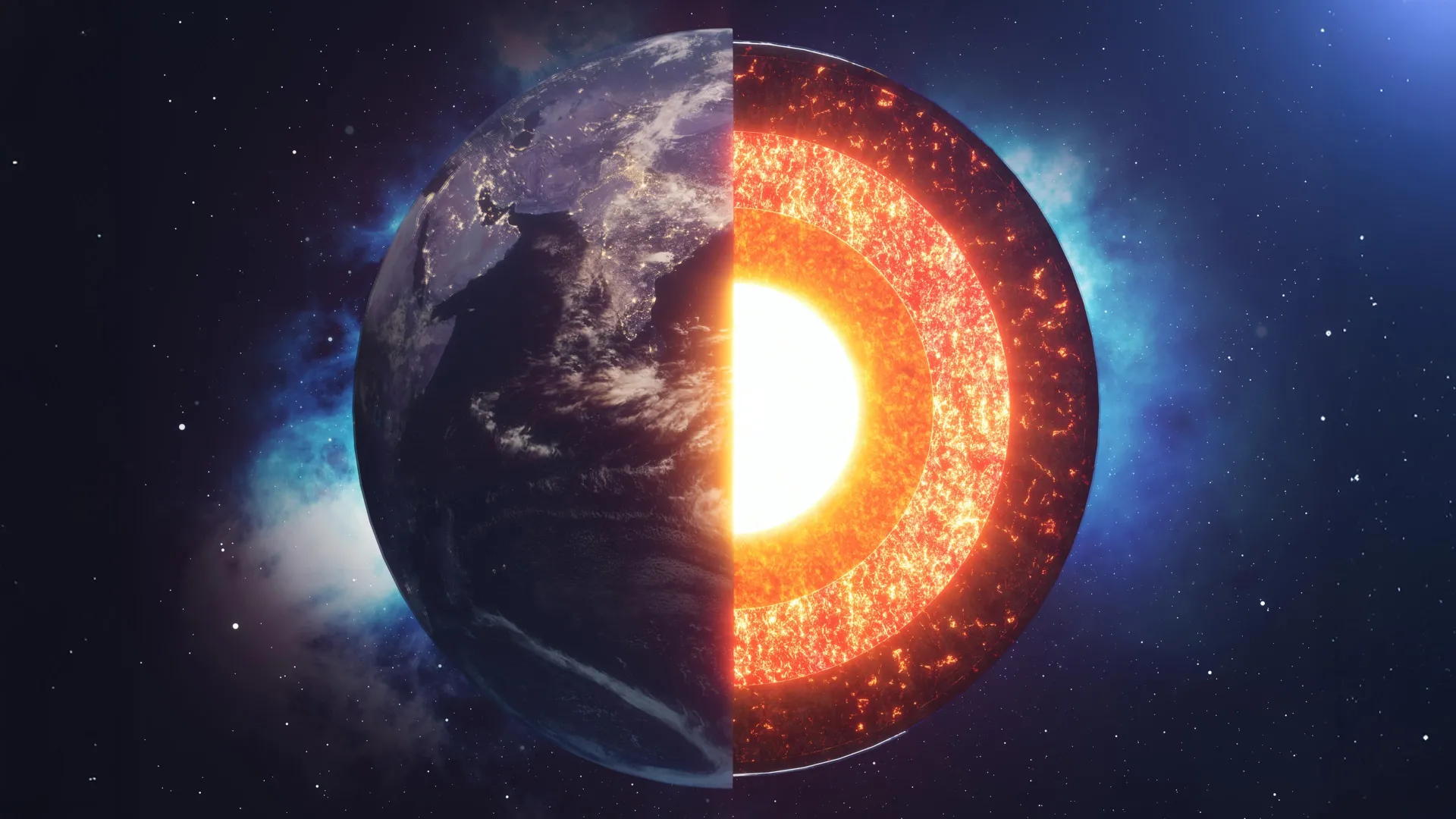
Research has revealed that Earth’s inner core exists in a previously unrecognized superionic state, where carbon atoms flow freely through a solid iron lattice. This finding, published in the National Science Review on December 10, 2025, challenges long-held assumptions about the nature of this densely packed region beneath the Earth’s molten outer core.
The inner core, a compact sphere composed of an iron and light-element alloy, is subjected to pressures exceeding 3.3 million atmospheres and temperatures comparable to the surface of the Sun. For years, scientists have grappled with the inner core’s peculiar behavior, which has been likened to that of a softened metal. Though solid, it slows seismic shear waves and exhibits a Poisson’s ratio more akin to butter than steel, leading researchers to question how such a rigid structure could also demonstrate flexibility.
Groundbreaking Research and Experimental Evidence
A team of researchers led by Prof. Youjun Zhang and Dr. Yuqian Huang from Sichuan University, along with Prof. Yu He from the Institute of Geochemistry, Chinese Academy of Sciences, conducted an extensive investigation that provides a strong explanation for these anomalies. They found that the inner core does not behave like a typical solid. Instead, it transitions into a superionic state under extreme conditions, allowing light elements to move through a stable iron framework as if they were liquid.
“For the first time, we’ve experimentally shown that the iron-carbon alloy under inner core conditions exhibits a remarkably low shear velocity,” said Prof. Zhang. This groundbreaking study reveals that carbon atoms travel rapidly through the iron lattice, significantly decreasing the alloy’s stiffness.
To achieve these results, the researchers employed a dynamic shock compression platform, propelling iron-carbon samples to speeds of 7 kilometers per second. This process generated pressures of up to 140 gigapascals and temperatures near 2600 Kelvin, accurately mimicking the conditions present in the inner core. By combining in-situ sound velocity measurements with advanced molecular dynamics simulations, the team observed a significant decrease in shear wave speed, confirming the core’s unexpectedly soft seismic characteristics.
Implications for Earth’s Magnetic Field and Planetary Science
The revelation of a superionic core not only addresses longstanding seismic anomalies but also enhances our understanding of Earth’s geophysical processes. The mobility of light elements could provide an explanation for seismic anisotropy—directional variations in seismic wave speeds—and may contribute to the maintenance of Earth’s magnetic field.
“Atomic diffusion within the inner core represents a previously overlooked energy source for the geodynamo,” noted Dr. Huang. “In addition to heat and compositional convection, the fluid-like motion of light elements may help power Earth’s magnetic engine.”
This study also sheds light on the behavior of light elements under extreme pressure, emphasizing the importance of interstitial solid solutions, particularly those involving carbon, in determining the core’s physical properties.
According to Prof. Zhang, this research signifies a major shift in scientists’ understanding of the inner core. “We’re moving away from a static, rigid model of the inner core toward a dynamic one,” he explained. The implications of this discovery extend beyond Earth, as identifying a superionic phase may enhance our comprehension of magnetic and thermal evolution in other rocky planets and exoplanets.
These findings bring researchers closer to unlocking the complexities of Earth’s interior and could have far-reaching implications for the study of similar planetary bodies throughout the universe. The research was supported by the National Natural Science Foundation of China, the Sichuan Science and Technology Program, and the CAS Youth Interdisciplinary Team.