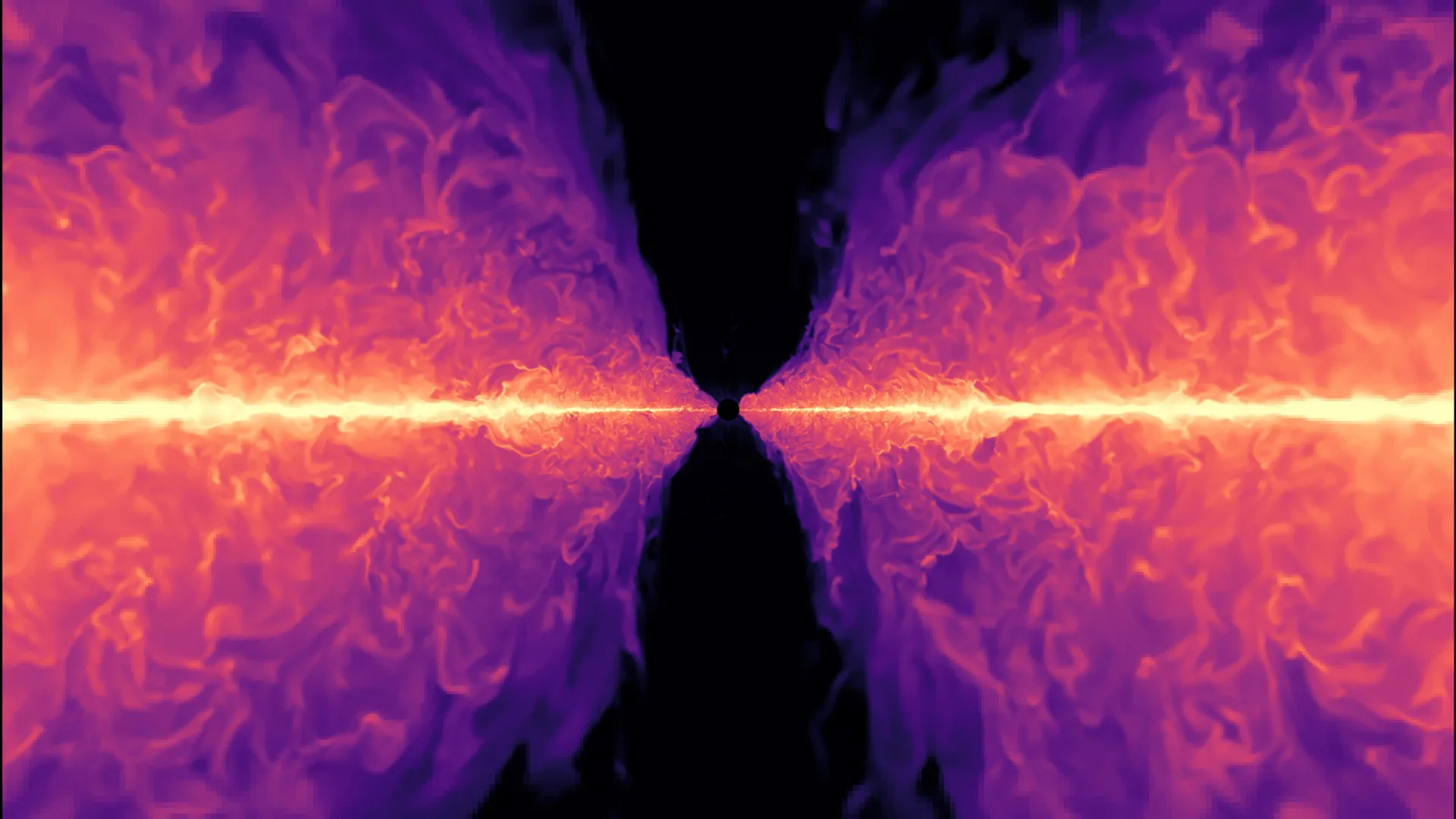
A groundbreaking simulation has unveiled new insights into the behavior of black holes, marking a significant advancement in astrophysics. Researchers from the Institute for Advanced Study and the Flatiron Institute have developed a sophisticated model that accurately combines Einstein’s theory of gravity with the complex dynamics of light and matter. This innovative framework allows for a deeper understanding of how matter interacts with black holes, particularly during the accretion process, where surrounding material is drawn in and radiates intense energy.
The study, published in The Astrophysical Journal on December 22, 2025, represents a pivotal moment in computational astrophysics. For the first time, scientists have successfully simulated black hole environments without relying on simplifying assumptions. By utilizing some of the most powerful supercomputers available, including the Frontier at Oak Ridge National Laboratory and Aurora at Argonne National Laboratory, the team has created a model that reflects the intricate realities of black hole accretion.
Researchers focused on stellar mass black holes, which are typically around ten times the mass of the Sun. These smaller black holes offer distinct advantages for study, as they evolve rapidly, allowing scientists to observe significant changes in real time. Lizhong Zhang, the lead author and a joint postdoctoral research fellow at the Institute for Advanced Study and the Flatiron Institute, emphasized that the new model accurately reproduces the chaotic behavior of matter as it spirals into black holes, forming turbulent, glowing disks and generating powerful outflows.
Advancements in Black Hole Research
The research team achieved a breakthrough by directly solving the complex equations governing black hole physics without approximations. Previous models treated radiation as a fluid, which failed to capture its true behavior. The new algorithm developed by the team allows for a more realistic representation, leading to a significant enhancement in simulation accuracy.
Zhang noted, “This is the first time we’ve been able to see what happens when the most important physical processes in black hole accretion are included accurately. These systems are extremely nonlinear—any oversimplifying assumption can completely change the outcome.” The simulations not only aligned with theoretical predictions but also matched real astronomical observations, providing a more confident basis for future studies.
The potential applications of this research extend beyond stellar mass black holes. The simulation framework may also shed light on supermassive black holes, such as Sgr A*, located at the center of the Milky Way. These massive entities play a crucial role in shaping galaxies, and understanding their dynamics is essential for astrophysical research.
Future Directions in Astrophysics
Looking ahead, the team plans to expand their research to encompass various types of black holes. This will involve refining how radiation interacts with matter across diverse temperatures and densities. Co-author James Stone, a professor at the Institute for Advanced Study, remarked on the unique nature of this project, highlighting the extensive effort involved in developing the applied mathematics and software required for such complex simulations.
The implications of this research are profound, as they not only enhance our understanding of black holes but also pave the way for future investigations into the cosmos. With the ability to simulate black hole environments more accurately than ever before, scientists are poised to unlock further secrets of the universe.
This study exemplifies the fusion of advanced computational power and theoretical physics, underscoring the role of supercomputers in modern scientific discovery. As researchers continue to explore these enigmatic objects, the insights gained will undoubtedly deepen our understanding of the fundamental workings of the universe.