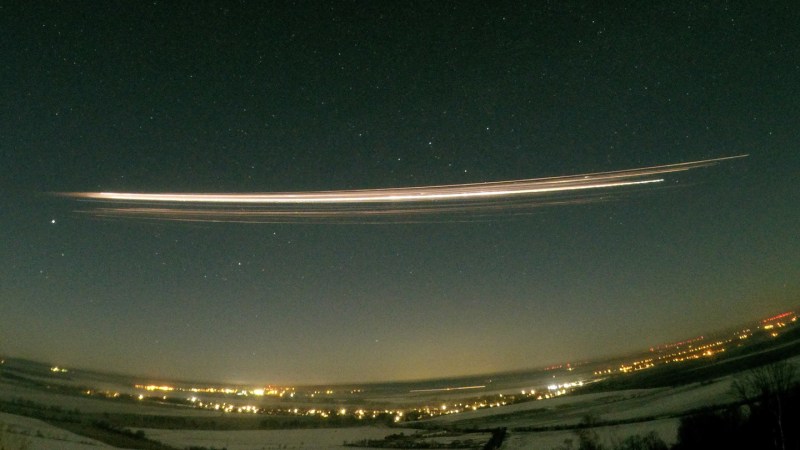
For the first time, scientists have directly identified metal pollutants released during the reentry of a piece of space debris. A Falcon 9 rocket from SpaceX disintegrated in the atmosphere, revealing that metals such as lithium were emitted, potentially harming the ozone layer. Researchers published their findings on February 19, 2025, in the journal Communications Earth and Environment, highlighting the implications of increased space debris as commercial satellite launches grow.
The launch of metal objects into orbit has been a common practice for nearly 70 years, but the frequency has surged in recent years. Private companies, particularly SpaceX, plan to significantly expand their satellite constellations. The Starlink system aims to deploy over 40,000 satellites in low-Earth orbit, with nearly 10,000 already in operation. Each satellite is designed to operate for about five years before it burns up upon reentry, releasing metals into the atmosphere.
A 2023 study indicated that approximately 10 percent of stratospheric particles contain pollutants from burned satellites and rocket stages. This prompted a research team led by meteorologist Claudia Stolle from the Leibniz Institute of Atmospheric Physics in Germany to investigate whether they could trace these pollutants back to specific reentering debris.
On the day of the observation, researchers detected a lithium plume approximately 100 kilometers above Germany, emanating from the disintegrating Falcon 9 rocket over Ireland and the United Kingdom. “A few hours after the reentry of this rocket, we could see 10 times more lithium than we would have observed otherwise,” Stolle explained.
Utilizing lidar technology, which employs laser pulses tuned to specific wavelengths, the team successfully identified the presence of lithium in the atmosphere. They also conducted advanced atmospheric simulations to demonstrate that prevailing winds transported the lithium from the reentry site across the North Atlantic to the location in Kühlungsborn, Germany, where the lidar instruments were positioned.
While a natural influx of metals into the atmosphere occurs from meteorites, the research team concluded that the cumulative effect of reentering space debris could increase metal pollution by as much as 40 percent. As more companies and countries become involved in launching satellites, monitoring such pollutants and their environmental impact will be crucial.
Stolle emphasized the inevitability of satellite reentries, stating, “All of them will burn up sooner or later.” With the rapid growth of space operations, understanding the implications of metal pollution has never been more urgent. The findings pave the way for future research that could help mitigate the environmental effects of space debris on Earth’s atmosphere.