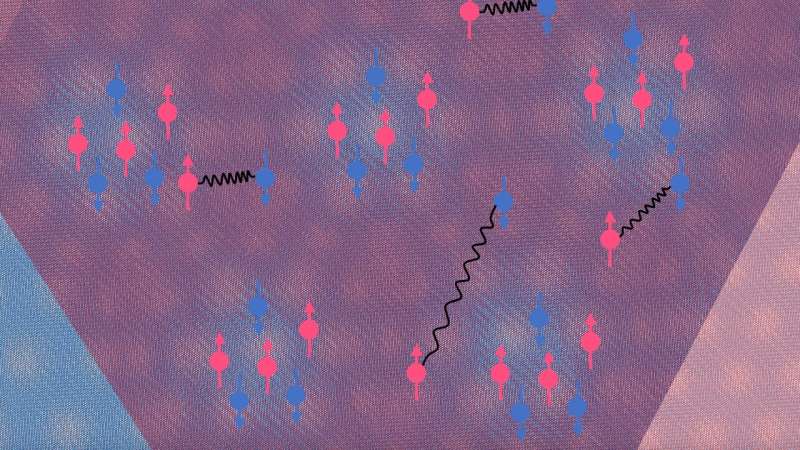
A groundbreaking study has revealed strong superconductivity in a newly identified structure known as a supermoiré lattice. This discovery, announced on February 15, 2026, by researchers from institutions including the Ecole Polytechnique Fédérale de Lausanne and Freie Universität Berlin, could significantly advance the field of quantum materials.
The supermoiré lattice is formed by stacking two or more graphene layers at a slight twist angle, creating a unique moiré pattern that influences electron movement. The research team, led by senior author Mitali Banerjee, initially intended to create a device with identical twist angles in the graphene layers. However, during experimentation, Zekang Zhou uncovered a fundamentally different phase diagram that prompted further investigation.
As the team applied an electric field in both directions, the newly developed device exhibited distinct behaviors, leading to the emergence of resistive states across various regions of the material. Banerjee noted, “The rich phase diagram inspired us to pursue this system. The project developed in a direction we had not originally anticipated.”
Exploring Superconductivity in Twisted Graphene
The primary goal of the study was to determine whether strong superconductivity could manifest in a twisted trilayer graphene system characterized by broken mirror symmetry. To achieve this, the researchers conducted a series of low-temperature electrical transport measurements. “We measured its electrical resistance while carefully tuning two key parameters: the carrier density and the displacement field,” explained Banerjee.
A transition to a superconducting state is indicated by a dramatic drop in electrical resistance to nearly zero. The team observed this near-zero resistance, suggesting the emergence of superconducting states. Banerjee elaborated, “To verify that this zero-resistance state corresponds to superconductivity, we performed standard characterization measurements.”
Temperature-dependent tests confirmed that the superconducting state diminishes as temperature increases. The researchers also noted strong nonlinear transport behavior, indicating a transition from the superconducting state to the normal state above a specific direct current, which is also influenced by applied magnetic fields.
Significance of the Supermoiré Lattice
The study revealed that superconducting states within the device were uniquely suppressed by magnetic fields due to the broken mirror symmetry, yet robust superconductivity remained observable. Banerjee stated, “Despite this symmetry breaking, we still observed robust superconducting regions with clear critical temperatures and critical magnetic fields.”
The measurements further identified a supermoiré lattice through phenomena known as Brown-Zak oscillations, which occur when electrons synchronize with a repeating lattice pattern under a magnetic field. This synchronization led to oscillating resistance patterns, confirming the presence of a supermoiré lattice in the graphene layers.
Looking ahead, the researchers aim to leverage their findings to inform the design of quantum materials. Banerjee remarked, “Our findings demonstrate that, in twisted multilayer systems, the interference between distinct moiré lattices constitutes a new degree of freedom.” This new degree of freedom could facilitate the exploration of novel quantum states and enhance the development of advanced electronic materials.
The study represents a significant step in understanding and manipulating quantum phases within twisted systems. As researchers continue to investigate the microscopic origins of superconductivity in these new structures, they hope to uncover the precise conditions that stabilize supermoiré lattices and their potential applications in cutting-edge technologies.
This research, published in Nature Physics, underscores the promising future of twisted graphene systems as platforms for realizing complex quantum phenomena.