Researchers at the Helmholtz-Zentrum Dresden-Rossendorf (HZDR) have identified new oscillation states, known as Floquet states, in magnetic vortices. This discovery, published in the journal Science on January 8, 2026, reveals that a subtle excitation using magnetic waves can create these states, challenging previous methods that relied on energy-intensive laser pulses.
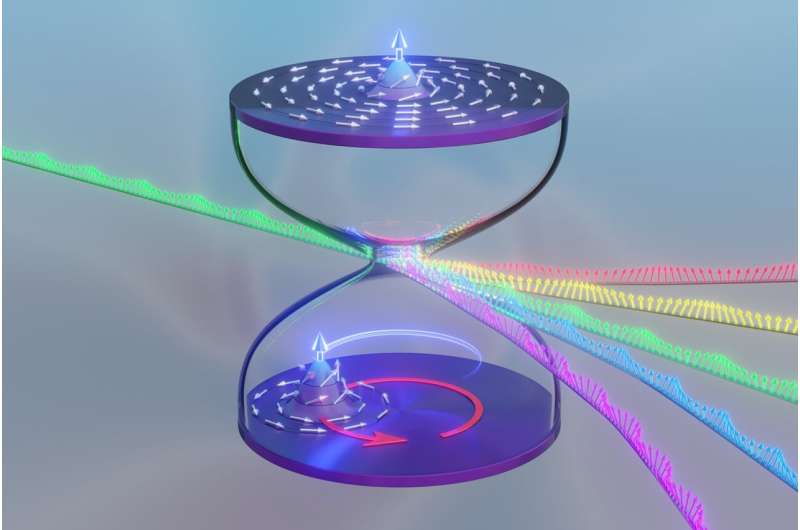
The study focused on ultrathin magnetic disks, measuring just a few micrometers in diameter, made from materials such as nickel–iron. Within these disks, the magnetic moments align in circular formations, forming vortices. When these vortices are disturbed, they generate collective wave excitations called magnons, which can transmit information without the need for charge transport. Dr. Helmut Schultheiß, the project leader, emphasized the significance of this mechanism for advancing next-generation computing technologies.
The research team initially aimed to explore the potential of smaller magnetic disks for neuromorphic computing. As they analyzed their data, they discovered that some disks produced multiple resonance lines rather than a single one. “At first we assumed it was a measurement artifact,” Schultheiß noted. “But when we repeated the experiment, the effect reappeared. That is when it became clear we were looking at something genuinely new.”
Significance of Floquet States
The phenomenon stems from the mathematical principles established by French mathematician Gaston Floquet in the late 19th century. He posited that periodic driving could induce new states in systems. The HZDR team found that in magnetic vortices, Floquet states can emerge spontaneously if magnons are sufficiently excited. This results in a tiny circular motion of the vortex core, which rhythmically modulates the magnetic state.
The experimental outcome presents itself as a frequency comb, where multiple lines appear instead of a single resonance, akin to how a pure tone can split into harmonic overtones. Schultheiß expressed his astonishment, stating, “We were stunned that such a minute core motion was enough to transform the familiar magnon spectrum into a whole array of new states.”
Potential Applications and Future Research
The efficiency of this process is noteworthy, requiring only microwatt-level energy inputs—far less than the high-power laser pulses typically needed for such experiments. This low energy requirement opens up fascinating possibilities for synchronizing disparate systems, enabling connections between ultrafast terahertz phenomena and conventional electronic or quantum components. Schultheiß referred to this capability as a “universal adapter,” likening it to a USB adapter that allows different devices to work together.
Looking forward, the research team plans to investigate whether this phenomenon can be extended to other magnetic structures. The implications of their findings may prove invaluable for developing new computing architectures, facilitating interactions among magnonic signals, electronic circuits, and quantum systems.
Schultheiß highlighted the dual nature of their discovery, stating, “On the one hand, our discovery opens new avenues for addressing fundamental questions in magnetism. On the other hand, it could eventually serve as a valuable tool to interconnect the realms of electronics, spintronics, and quantum information technology.”
The Labmule program, developed at HZDR, played a crucial role in automating lab measurements and analyzing data from various measuring devices throughout this research.
For further details, see the full study: Christopher Heins et al, “Self-induced Floquet magnons in magnetic vortices,” published in Science (2026). DOI: 10.1126/science.adq9891.