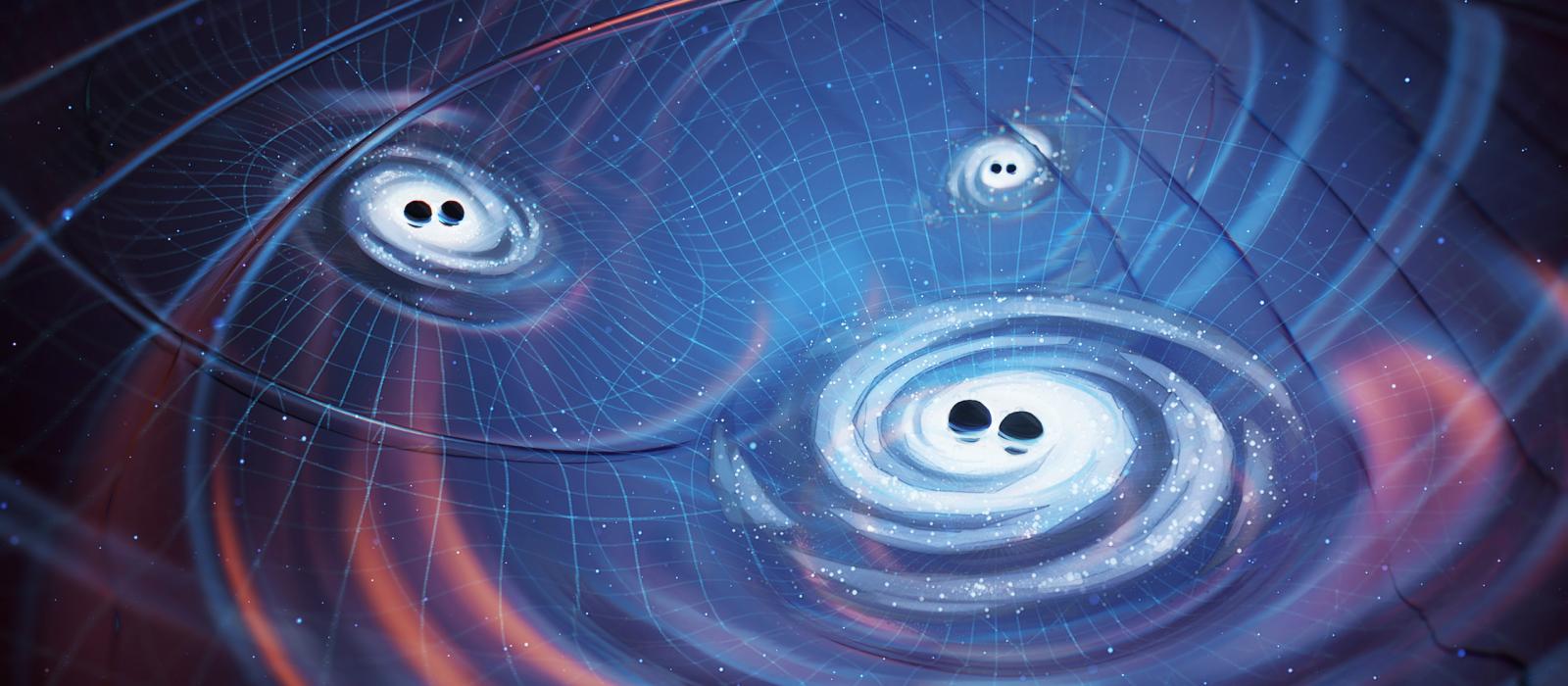
The University of Amsterdam (UvA) has made significant strides in understanding Dark Matter through a new study on gravitational waves (GWs). This research, published in the journal Physical Review Letters, outlines how GWs generated by merging black holes could help scientists decode the elusive nature of Dark Matter, which constitutes approximately 65% of the universe’s mass.
The discovery of GWs in 2015 confirmed a key prediction of Albert Einstein’s Theory of General Relativity, sparking a revolution in the field of astronomy. These waves are produced when massive celestial bodies, like black holes and neutron stars, collide, creating ripples in spacetime detectable from millions of light-years away.
New Framework for Understanding Dark Matter
Led by researchers Rodrigo Vicente, Theophanes K. Karydas, and Gianfranco Bertone at UvA’s Institute of Physics and the Gravitation & Astroparticle Physics Amsterdam (GRAPPA), the study introduces an improved model that examines how GWs interact with Dark Matter. The research focuses on phenomena known as Extreme Mass-Ratio Inspirals (EMRIs), which occur when smaller black holes or neutron stars spiral into larger black holes.
Historically, studies have simplified the complex interactions between black holes and their surrounding environments. The latest findings leverage General Relativity, providing a comprehensive framework that accounts for various environments influencing the orbits of EMRIs and the associated GWs. This approach aims to reveal how concentrated regions of Dark Matter may leave distinctive signatures on GW signals.
The implications of this work extend beyond theoretical models; it sets the stage for future observational opportunities. By analyzing GWs with advanced instruments, scientists can potentially confirm the existence of Dark Matter and enhance our understanding of its properties.
Future Observations and Significance
Looking ahead, the European Space Agency (ESA) plans to launch the Laser Interferometer Space Antenna (LISA) in approximately a decade. This mission will be the first dedicated observatory for studying GWs, employing three spacecraft equipped with six lasers to measure spacetime ripples. LISA is expected to detect over 10,000 GW signals throughout its operational lifespan.
The research from UvA not only anticipates findings from LISA but also complements ongoing projects like the Laser Interferometer Gravitational Wave Observatory (LIGO), the Virgo Collaboration, and the Kamioka Gravitational-wave Detector (KAGRA). It underscores a burgeoning research area focused on utilizing GWs to map Dark Matter distribution across the cosmos.
As scientists continue to unravel the mysteries of Dark Matter, studies like this one provide crucial insights into its nature and composition. By integrating advanced gravitational wave analysis with extensive astrophysical models, researchers are poised to make groundbreaking discoveries that could reshape our understanding of the universe.