A research team from the Korea Institute of Materials Science (KIMS) has made a significant advancement in marine technology by developing a high corrosion- and wear-resistant carbon coating. Led by Dr. Young-Jun Jang and Dr. Jongkuk Kim, in collaboration with Dr. Sungmo Moon, this breakthrough addresses the severe corrosion challenges associated with ammonia fuel, which is emerging as a key alternative for eco-friendly shipping.
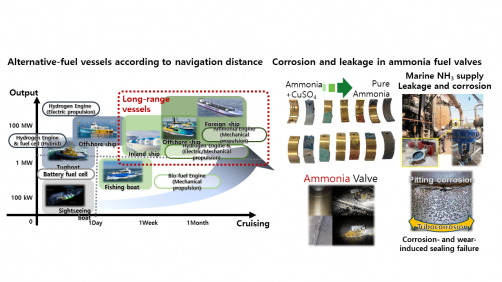
The innovative carbon coating technology, known as ta-C:Hx, offers a solution to the degradation that conventional marine metals, such as stainless steel 440C, experience when exposed to ammonia. This degradation is primarily caused by the strong alkalinity and chemical reactivity of ammonia, leading to the breakdown of protective oxide layers and subsequent corrosion. Fuel-contacting components, including engines, valves, pumps, and bearings, have been identified as particularly vulnerable, necessitating enhanced corrosion-resistant technologies.
The newly developed coating has demonstrated remarkable performance. Traditional marine materials exhibit corrosion current densities of about 48 μA/cm2 in ammonia environments, while the ta-C:Hx coating reduces this figure to just 4 μA/cm2, marking a reduction of approximately 92%. Furthermore, the corrosive wear rate has seen an impressive decline from 1.4 × 10⁻⁶ mm3/N·m for conventional stainless steel to 1.3 × 10⁻⁸ mm3/N·m for the new coating, achieving a reduction of 99.1% in tribocorrosion wear tests.
Addressing Industry Needs
This advancement is particularly timely, as the International Maritime Organization (IMO) has mandated a transition to zero-carbon fuels in international shipping by 2030. The Maritime Safety Committee has also approved interim guidelines requiring verification of corrosion resistance for materials used in ammonia fuel systems. This places further emphasis on the need for robust surface technologies in ammonia-powered vessels, a sector South Korea has identified as strategic through its “2050 Green Shipping National Action Plan.”
Despite South Korea’s progress in ammonia vessel designs, the lack of domestically developed surface coating technologies capable of withstanding corrosive environments has hindered commercialization efforts. The ta-C:Hx coating builds upon KIMS’s extensive expertise in carbon coating technologies and corrosion evaluation, positioning it as a leading solution in this critical area.
Dr. Jang highlighted the potential impact of this technology, stating, “If this technology is commercialized, it will provide a practical solution for long-distance operation by significantly improving the efficiency and reliability of key components for eco-friendly shipbuilding and marine vessels.” His co-researchers echoed this sentiment, noting the collaborative nature of the project as a key factor in its success.
Next Steps and Future Potential
Currently, the research team is involved in stabilizing the coating process and conducting reliability evaluations for ammonia fuel environments. They are also exploring follow-up demonstration studies to apply the technology to actual ship components. Additional patent filings are underway, and the team is actively seeking opportunities for technology transfer and commercialization through partnerships with industry stakeholders.
This research has garnered support from KIMS’s in-house program titled “Development of Practical Tribology Technologies for Cryogenic Environments” and the National Research Foundation of Korea (NRF), which funds the Nano and Materials Technology Development Program through the Ministry of Science and ICT. The findings were published in the renowned journal Carbon on December 1, 2025.
The implications of this research extend beyond national borders, with the potential to strengthen South Korea’s industrial ecosystem and enhance its competitive edge in the global market for eco-friendly shipping technologies.