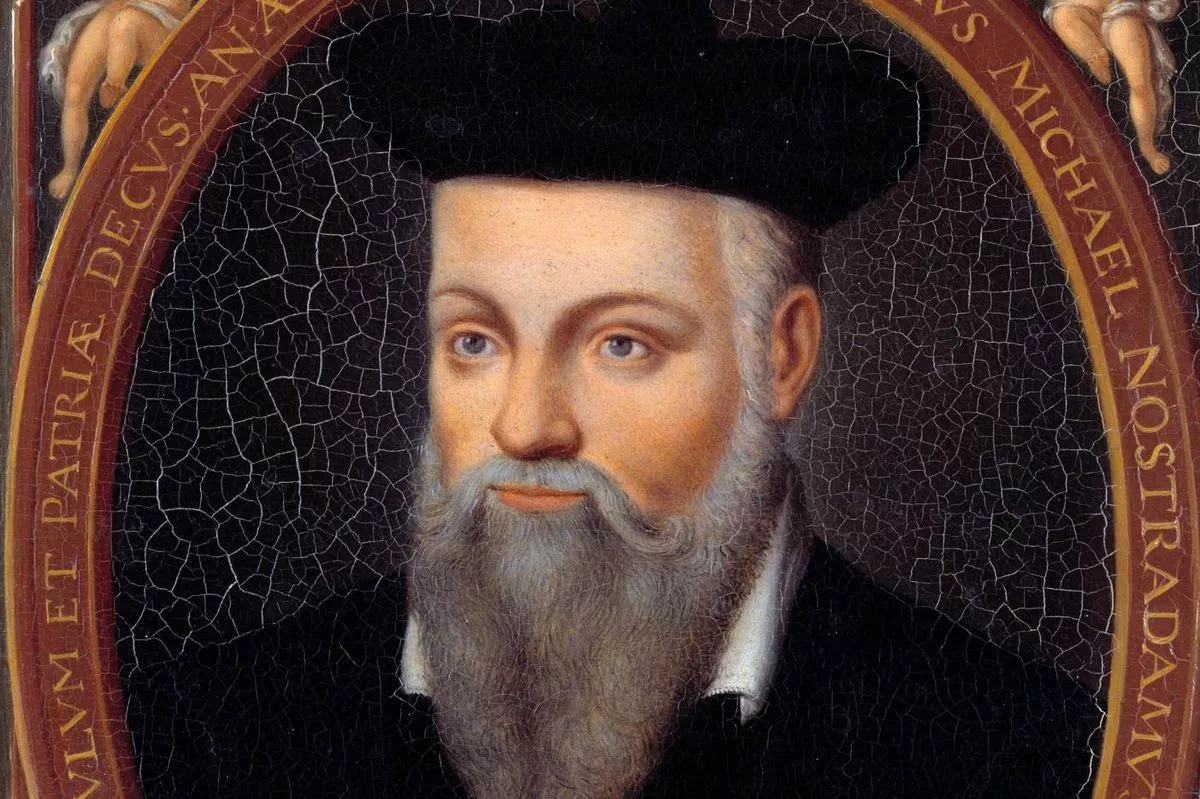
The prophecies of 16th-century French astrologer Nostradamus are once again capturing public attention as we approach 2026. His cryptic verses, published in his 1555 work, ‘The Prophecies’, have long been the subject of interpretation and speculation. As discussions about his predictions resurface, four specific forecasts have drawn particular interest, especially concerning potential global conflicts and natural calamities.
Nostradamus crafted his predictions in a series of 942 quatrains, many of which appear to address significant events in world history. One notable quatrain reads, “Seven months great war, people dead through evil/ Rouen, Evreux the King will not fail.” This line has been interpreted by some as a reference to the ongoing conflict between Russia and Ukraine, suggesting a period of intense warfare in the near future.
Historically, several interpretations of Nostradamus‘ work have linked his quatrains to major events. For instance, the phrase “Within two cities, there will be scourges the like of which was never seen” is purported to predict the nuclear bombings of Hiroshima and Nagasaki at the end of World War II, according to the Mirror. Such interpretations highlight the enduring fascination with his writings.
Another of Nostradamus‘ predictions raises eyebrows due to its unusual imagery. He states, “The great swarm of bees will arise by the night ambush,” a phrase that some speculate could occur in 2026. The association of this line with the number 26 has led to widespread conjecture. While the meaning of the “great swarm of bees” remains unclear, it is unlikely to signify a literal threat from bees.
A particularly striking prediction involves a figure of significance facing a perilous fate. In the 26th verse of Century I, Nostradamus mentions, “the great man will be struck down in the day by a thunderbolt.” This ambiguous line could refer to various individuals, from royalty to prominent public figures. The idea of a well-known personality meeting an unfortunate end during daylight has generated considerable media buzz.
Further adding to the intrigue, Nostradamus ominously notes, “Because of the favour that the city will show… the Ticino will overflow with blood…” This prediction seemingly points to the Ticino region in Switzerland, hinting at a potential disaster, whether it be a mass casualty event, a devastating plague, or a natural disaster.
While the allure of Nostradamus‘ predictions captivates many, skepticism also exists. Critics argue that his writings, composed in Middle French and laden with intentionally vague Latin terminology, lend themselves to multiple interpretations. The existence of numerous manuscripts, spelling variations, and evolving interpretations over centuries further complicates understanding his original intent.
As 2026 approaches, the resurgence of interest in Nostradamus‘ predictions continues to provoke debate. Whether viewed as prophetic wisdom or mere coincidence, his quatrains remain a source of fascination, reflecting humanity’s enduring desire to glimpse the future.