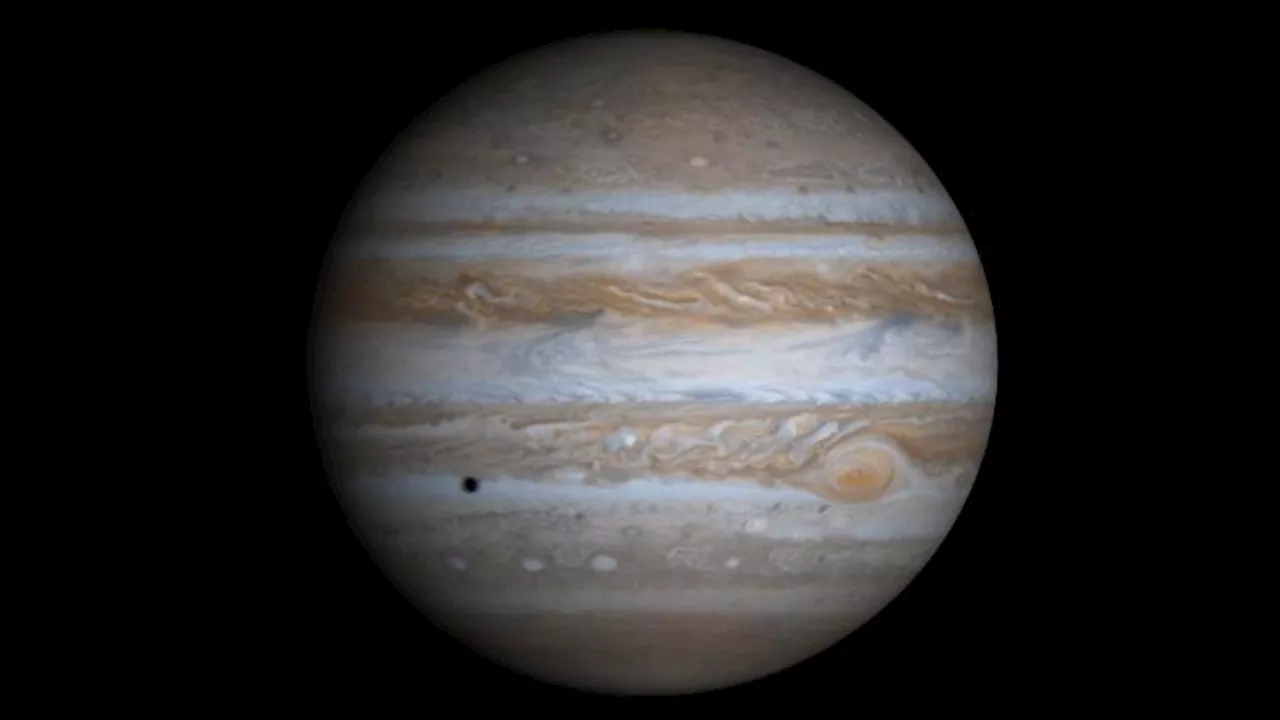
NASA’s Juno mission has provided a groundbreaking update on the size and shape of Jupiter, the largest planet in our solar system. Research reveals that Jupiter’s equatorial radius is approximately 5 miles smaller than previously estimated, and the distance from pole to pole is about 15 miles less. This new data marks a significant refinement in our understanding of the gas giant.
Over the course of its mission, Juno has utilized a technique known as radio occultation. This method involves sending radio signals from the spacecraft as it passes behind Jupiter. As these signals travel through the planet’s dense atmosphere, they bend and slow down, providing scientists with critical information about the atmosphere’s temperature, pressure, and overall structure. The results have demonstrated that Jupiter is not just smaller, but also more flattened at the poles than earlier calculations suggested.
Significance of the Findings
The updated measurements confirm that Jupiter is more squashed due to its rapid rotation, completing a full turn in less than 10 hours. Understanding the planet’s shape is crucial for scientists as it aids in comprehending the dynamics of its massive gravitational field, how energy circulates within its atmosphere, and the mysteries that lie beneath its swirling cloud tops.
Juno, which entered Jupiter’s orbit in 2016, has contributed significantly to planetary science by revealing insights into Jupiter’s magnetic field and deep atmospheric jets. This latest data not only enhances our grasp of Jupiter itself but also has broader implications for the study of gas giants and exoplanets. Accurate dimensions of Jupiter serve as a vital reference point for astronomers interpreting the characteristics of planets orbiting distant stars.
The Future of Planetary Research
The implications of Juno’s findings extend beyond Jupiter. As Jupiter is frequently used as a benchmark for understanding other gas giants, even minor adjustments to its dimensions can influence how scientists interpret observations of exoplanets. The adjustments to Jupiter’s known measurements may necessitate updates across scientific literature, reflecting the evolving nature of our understanding of celestial bodies.
As the scientific community continues to analyze data from Juno, the insights gained will undoubtedly enrich our knowledge of not just Jupiter, but also the broader dynamics of planetary systems. The mission highlights the importance of continuous exploration and research, reminding us that our understanding of the universe is always subject to refinement and enhancement.