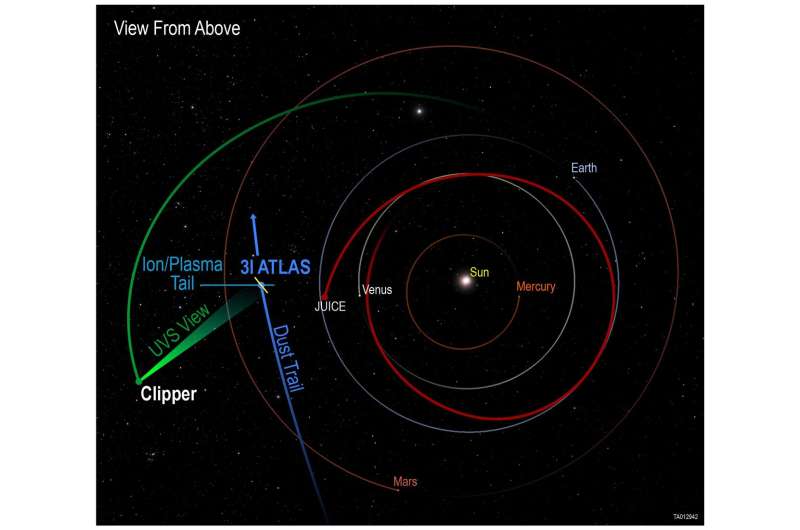
NASA’s Europa Clipper spacecraft has made significant observations of the interstellar comet 3I/ATLAS, marking a notable achievement in space exploration. The Ultraviolet Spectrograph (UVS), developed by the Southwest Research Institute (SwRI), captured a rare ultraviolet view of the comet during a period when ground-based observations were not feasible. This event occurred after 3I/ATLAS became the third officially recognized interstellar object to enter our solar system in July 2025.
The opportunity to observe the comet was unexpected, according to SwRI’s principal investigator for Europa-UVS, Dr. Kurt Retherford. He expressed enthusiasm about the unique insights these observations provide. The Europa Clipper, which launched in 2024, is scheduled to arrive in the Jovian system in 2030. It will conduct 49 close flybys of Jupiter’s moon, Europa, gathering data on its atmospheric gases and icy surface materials.
Following the comet’s discovery, analysts at NASA’s Jet Propulsion Laboratory (JPL) quickly determined its trajectory. The Europa Clipper team recognized that their spacecraft could observe 3I/ATLAS in November, a time when Earth-based observations were limited due to the sun’s position. This strategic timing allowed the UVS instrument to capture the comet from a unique vantage point, bridging the gap between earlier Mars-based observations and later Earth-based data.
Unique Observations from Europa Clipper
The UVS’s perspective enabled scientists to view the comet’s two distinct tails—dust and plasma—while looking back toward the comet’s nucleus and coma. This unusual sunward viewpoint provided essential data on the comet’s physical characteristics. In collaboration with data from the ESA’s Jupiter Icy Moons Explorer (JUICE), the Europa Clipper’s observations are expected to enhance understanding of the comet’s tail geometries.
Dr. Thomas Greathouse, co-deputy principal investigator of Europa-UVS, emphasized the potential for these findings. He noted that combined observations from various sources could contribute to a more comprehensive understanding of the comet’s behavior and structure.
During its observations, Europa-UVS detected key elements such as oxygen and hydrogen, indicating that comet 3I/ATLAS experienced a significant outgassing event shortly after its closest approach to the sun. Dr. Retherford highlighted the instrument’s capability to measure fundamental atomic transitions, allowing scientists to observe gases released from the comet, including the breakdown of water molecules into hydrogen and oxygen atoms.
Implications for Comet Research
Understanding the composition of 3I/ATLAS is crucial for gaining insights into its origins and evolution as it traveled through the galaxy to reach our solar system. Dr. Tracy Becker, also a co-deputy principal investigator of Europa-UVS, raised critical questions about the chemical processes involved in the comet’s formation and its similarities to the processes believed to have shaped our solar system.
As observations continue, the Europa Clipper’s findings will significantly contribute to the broader understanding of interstellar comets and their role in the cosmos. Researchers are hopeful that the data collected will help unravel the mysteries of these celestial travelers.
For more information on this groundbreaking research, visit the Southwest Research Institute’s website at https://www.swri.org/markets/earth-space/space-research-technology/space-science/planetary-science.