The upcoming launch of the Nancy Grace Roman Space Telescope is poised to significantly enhance the detection of exoplanets through gravitational microlensing. This innovative telescope aims to monitor a greater number of microlensing events with improved precision, specifically targeting high-magnification instances that could reveal the presence of multiple planets orbiting a single star.
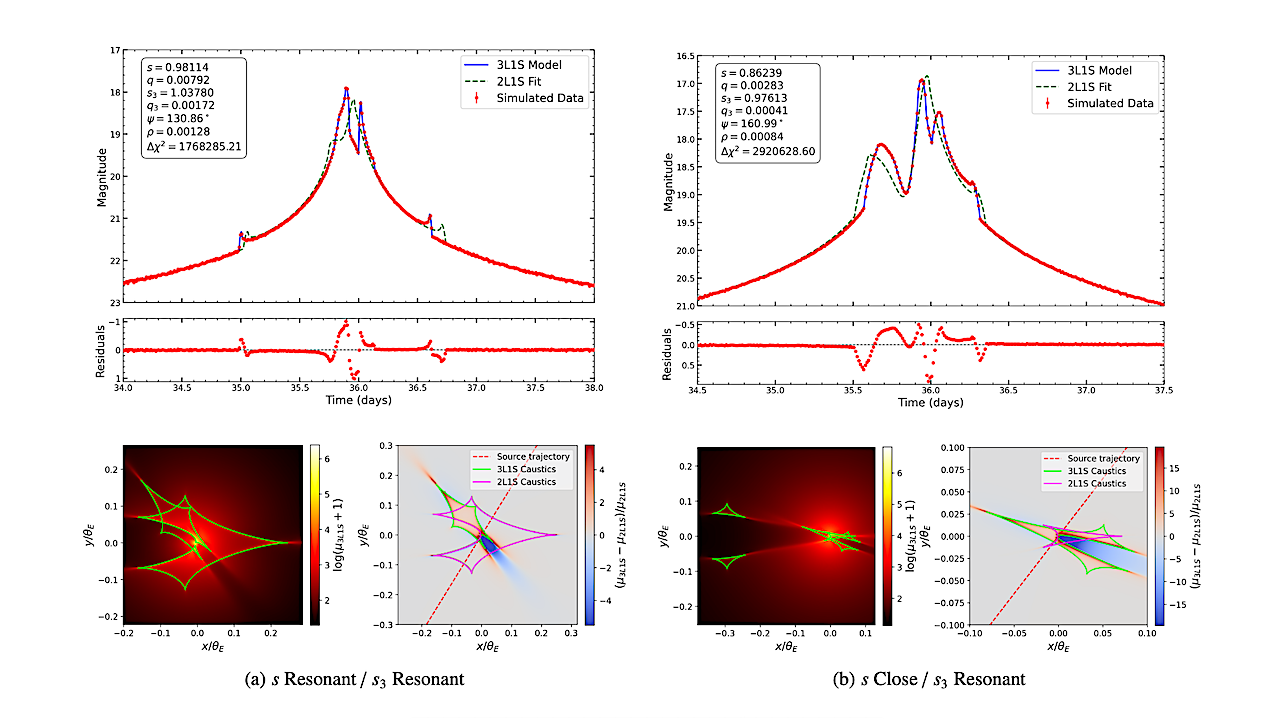
Research led by a team of astrophysicists, including Vito Saggese and Étienne Bachelet, focuses on the telescope’s ability to identify triple-lens microlensing systems. These systems occur when a star with two bound exoplanets creates observable anomalies during a microlensing event. By simulating a wide array of high-magnification microlensing light curves, the team assessed Roman’s projected performance during its observations aimed at the Galactic bulge.
The study established a detection criterion based on a required χ2 improvement for a two-planet model. This criterion helps determine whether a second planet can be clearly identified in contrast to a single-planet (binary-lens) scenario. The simulations indicated that Roman will successfully detect most two-planet microlensing events, particularly those where both planets have substantial masses, resulting in a planet-star mass ratio around 10^-3. In these cases, detection efficiencies could reach approximately 90%.
In contrast, the detection of systems comprising low-mass planets, represented by a mass ratio of around 10^-4, proves more challenging. These systems often generate insufficient signals that fall below detection thresholds. The research emphasized that the planetary mass ratios and their resulting caustic geometry—such as the size of central caustics in resonant versus widely spaced orbits—are critical factors affecting the detectability of these exoplanets.
Taking into account the likely frequency of planetary systems and the percentage of high-magnification events, the researchers estimate that Roman will detect a high-magnification triple-lens event in approximately 4.5% of all multi-planet microlensing occurrences. This translates to an anticipated total of about 64 events throughout the full duration of the survey.
The implications of these findings are significant for the field of astrophysics. The increased capability to identify multiple exoplanets may lead to a greater understanding of planetary system formation and diversity. As the launch approaches, the scientific community eagerly awaits the insights that the Nancy Grace Roman Space Telescope will bring to the study of exoplanets and their environments.