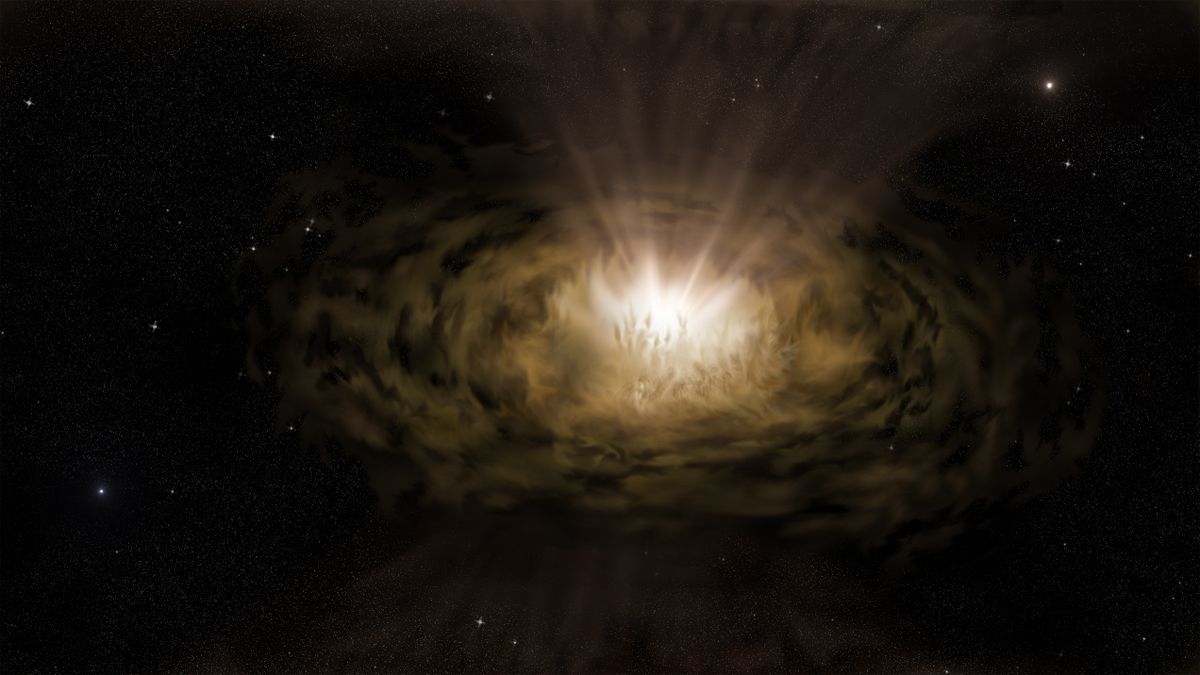
New insights from the James Webb Space Telescope (JWST) have brought to light the existence of supermassive black holes that traditional detection methods often overlook. This groundbreaking research, conducted by a team of astronomers and published in February 2024, highlights the role of these quiet galactic engines in shaping the dynamics of their surrounding galaxies.
Researchers utilized the advanced capabilities of the JWST to probe regions of space previously deemed too faint or obscured for conventional telescopes. The study indicates that these hidden supermassive black holes can exert significant gravitational influence, affecting the movement and formation of stars and gas within galaxies. The implications of these discoveries extend beyond our understanding of individual galaxies, suggesting a broader impact on the evolution of the universe itself.
Uncovering the Invisible
The JWST’s high-resolution imaging and spectroscopy capabilities allow scientists to detect subtle emissions from black holes that are otherwise masked by surrounding cosmic material. This technology has enabled researchers to identify several previously undetected supermassive black holes in various galaxies. According to the findings, these black holes are not only more common than previously believed, but they also play a crucial role in maintaining the structure of their host galaxies.
Dr. Emily Chen, a leading astrophysicist involved in the study, emphasized the significance of these findings, stating, “Understanding the presence and influence of these hidden black holes can revolutionize our comprehension of galaxy formation and evolution.” The research highlights that these quiet giants can act as stabilizing forces in their host galaxies, countering chaotic gravitational interactions.
Implications for Cosmic Understanding
The research provides compelling evidence that supermassive black holes may be integral to galaxy formation. The gravitational pull of these entities can help regulate star formation rates, influencing the overall mass and structure of galaxies. The study suggests that without these hidden black holes, galaxies might evolve in drastically different ways, potentially altering the landscape of the universe.
The team plans to continue using the JWST to explore additional galaxies, seeking to uncover more about the hidden dynamics at play. Their ongoing research aims to quantify the number of supermassive black holes in various cosmic environments, shedding light on their distribution and influence.
These discoveries also underscore the importance of advanced astronomical technology, such as that developed by the NASA and the European Space Agency (ESA). As scientists further analyze the data collected by the JWST, the potential for new revelations about the universe’s structure and history grows.
In summary, the findings from the James Webb Space Telescope not only deepen our understanding of supermassive black holes but also reshape our perspective on galaxy evolution. As researchers continue their work, the quest to decode the mysteries of the cosmos remains as exhilarating as ever.