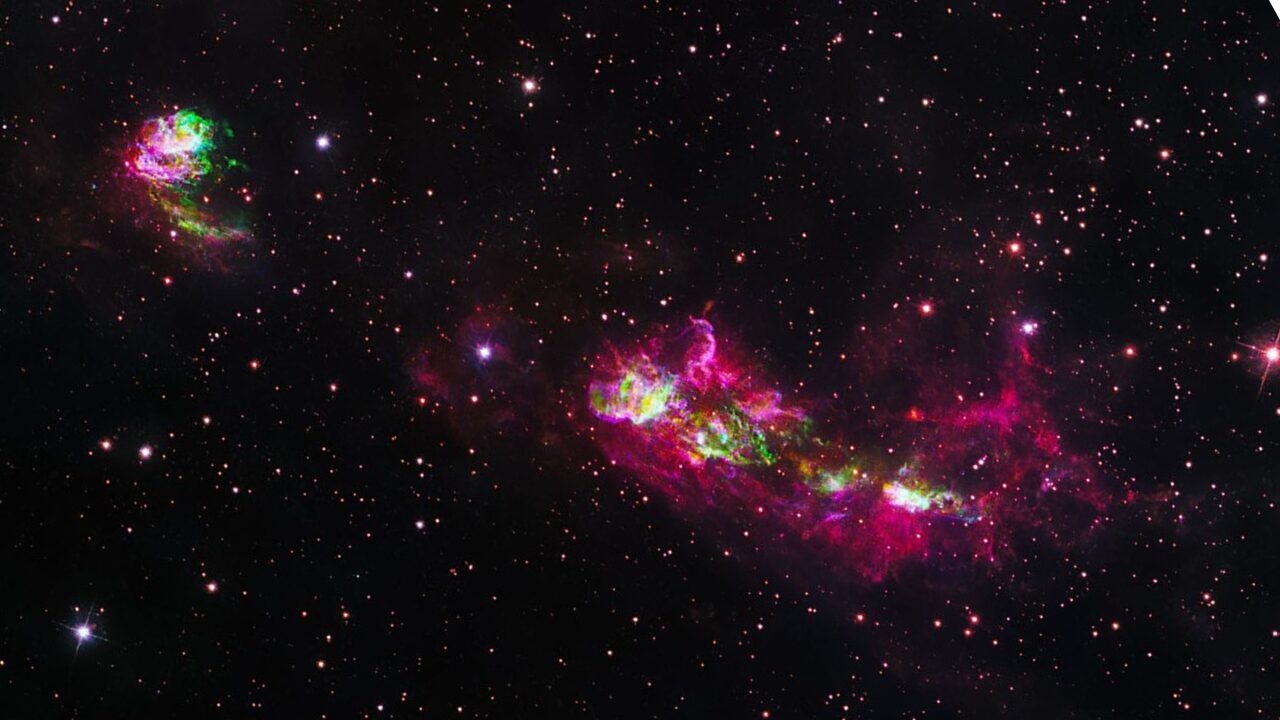
Astronomers using the Hubble Space Telescope have made a groundbreaking observation of an infant star, known as IRAS 18162-2048, which is approximately 20 times more massive than the sun. This young star is igniting interstellar clouds with a powerful stellar jet that travels at an astonishing speed of 2.2 million miles per hour (3.5 million kilometers per hour). The jet represents the fastest outflow of its kind ever recorded and stretches an extraordinary 32 light-years into space, making it the longest outflow from a forming star observed to date.
The spectacular images captured by Hubble reveal two Herbig-Haro (HH) objects, designated HH 80 and HH 81, glowing in vibrant neon green and pink. Located around 5,500 light-years from Earth, these objects are illuminated by IRAS 18162-2048, which resides in the molecular cloud known as L291. The size of the outflow is notable, being approximately 8 to 10 times wider than our entire solar system.
The formation of protostars like IRAS 18162-2048 occurs when gas from surrounding clouds condenses and begins to fall towards them. Due to angular momentum, this gas does not fall directly into the star but instead forms an accretion disk around it. This disk acts like a cosmic feeding bottle, gradually providing material to the star.
Nevertheless, the process is far from tidy. Powerful magnetic fields direct plasma from the accretion disk to the poles of the protostar, accelerating it to high velocities, which then result in the ejection of jets. The outbursts from IRAS 18162-2048 create shockwaves as they collide with previously ejected gas, generating the bright emissions observed in HH 80 and HH 81.
First identified by Hubble in 1995, HH 80 and HH 81 are remarkable not only for the size and speed of their powering jet but also because this is the only recorded instance of a jet driven by a young massive star, in contrast to the more common jets produced by low-mass stars.
The remarkable imagery of HH 80 and HH 81, showcasing intricate details of these cosmic phenomena, was made possible by the advanced capabilities of Hubble’s Wide Field Camera 3. This observation highlights the ongoing importance of the Hubble Space Telescope, which continues to provide invaluable data for astronomers even after more than 36 years in operation.
As researchers delve deeper into the mysteries of star formation and stellar outflows, the data gathered from such observations could illuminate our understanding of the universe’s evolution and the life cycle of stars. The enduring legacy of the Hubble Space Telescope underscores its role as a vital instrument in the exploration of cosmic phenomena.