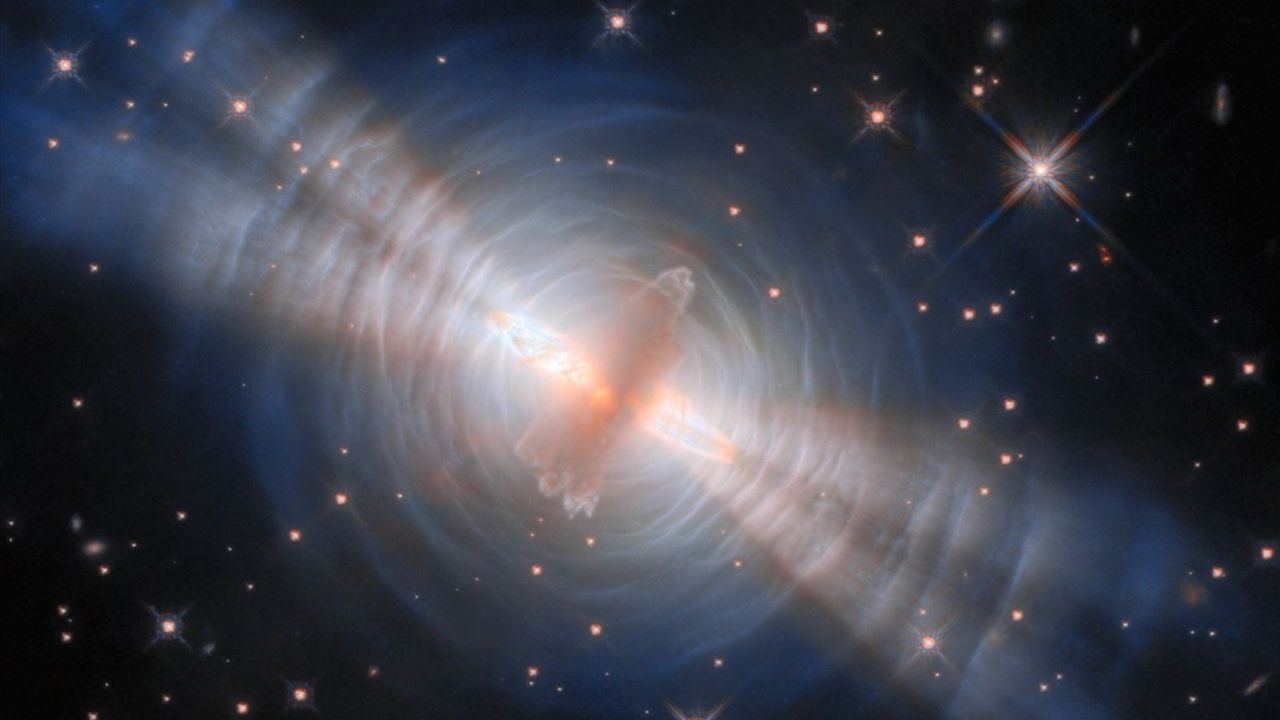
The Hubble Space Telescope has provided an extraordinary glimpse into the final moments of a dying star located in the constellation Cygnus, approximately 1,000 light-years from Earth. This star, enveloped in the Egg Nebula, showcases a breathtaking display as it approaches the end of its life cycle. The captivating images reveal twin beams of light penetrating through a swirling mass of gas and dust, marking a significant moment in stellar evolution.
The Egg Nebula is classified as a pre-planetary nebula, an early phase of development for what will eventually become a planetary nebula. Unlike typical nebulas that emit their own light through ionized gas, the illumination in the Egg Nebula originates from the dying star itself, which shines through openings in its dusty exterior. According to NASA, this nebula is “the first, youngest, and closest pre-planetary nebula ever discovered,” making it a crucial subject for scientific study.
Insights into Stellar Evolution
The pre-planetary stage of a nebula is relatively short-lived, lasting only a few thousand years. This characteristic provides astronomers with a unique opportunity to observe the ejection process of material in near real time. As the star’s core heats up, it will begin to ionize the surrounding gas, transforming the nebula into a glowing shell of gas and dust. This phase represents an essential transition in the star’s life cycle and contributes to the formation of future star systems.
Initial observations of the Egg Nebula have revealed symmetrical patterns within its structure. These orderly formations suggest that the patterns did not result from a chaotic supernova explosion. Instead, they likely arise from a sequence of poorly understood events occurring in the carbon-rich core of the dying star. NASA highlights the need for further research to unravel the complexities behind these phenomena.
By synthesizing both past and recent observations from the Hubble Space Telescope, researchers have constructed the most detailed portrait of the Egg Nebula to date. This intricate analysis offers new insights into how dying stars influence the material that ultimately contributes to the birth of new stars and planets, furthering our understanding of the cosmos.
The stunning visuals captured by Hubble not only enhance our appreciation for the beauty of the universe but also serve as a vital tool for scientists studying the life cycles of stars. As the Egg Nebula continues to evolve, it stands as a testament to the dynamic processes that govern the life and death of celestial bodies.