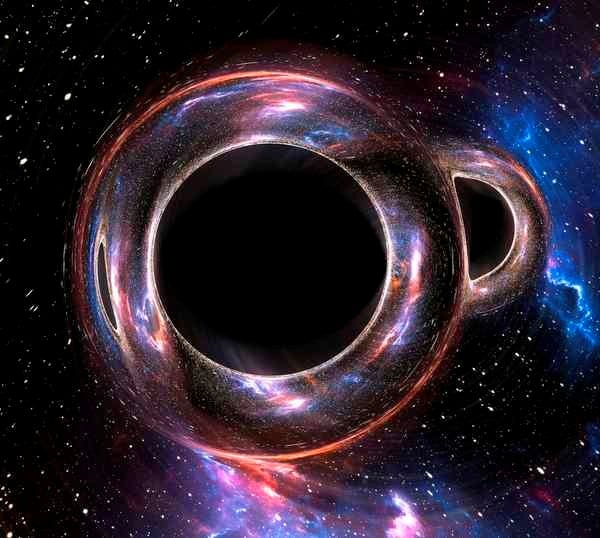
On January 14, 2025, scientists detected the clearest gravitational wave signal to date, designated GW250114. This remarkable discovery, made at the twin Laser Interferometer Gravitational Wave Observatories (LIGO) in the United States, offers new insights into the fundamental laws governing our universe. The signal originated from the collision of two black holes in deep space, and its exceptional clarity is paving the way for enhanced tests of Albert Einstein’s theory of general relativity.
The significance of this detection lies not only in the event itself but in the quality of the signal that reached Earth. When two black holes merge, they produce gravitational waves that resonate like the sound of a bell. These waves emit specific frequencies that gradually diminish over time. The characteristics of these frequencies, or “tones,” are defined by two key parameters: how rapidly they oscillate and how quickly they fade.
Measuring just one tone from a collision allows scientists to calculate the mass and spin of the newly formed black hole. However, obtaining two distinct tones from the same event provides independent measurements of the black hole’s properties. For GW250114, researchers successfully measured two tones and constrained a third, with all three measurements aligning perfectly with Einstein’s predictions. This result reaffirms the robustness of general relativity, which continues to withstand rigorous examination.
Exploring the Limits of General Relativity
Despite this successful validation, some physicists, including Keefe Mitman from Cornell University, express their belief that Einstein’s theory may be incomplete. General relativity does not account for phenomena such as dark matter and dark energy, nor does it effectively describe how gravity operates at the quantum level. The mathematical framework of general relativity fails when scientists attempt to integrate it with quantum mechanics, suggesting that there are aspects of the universe that remain unexplained.
The discovery of GW250114 serves as both a confirmation of Einstein’s theories and a promise for future exploration. With increasingly sensitive detectors, researchers are closing in on the boundaries where general relativity may falter. As they continue to probe these limits, the universe may ultimately reveal profound truths about its most intricate workings.
As scientists build on this groundbreaking work, the implications for our understanding of gravity, the cosmos, and the fundamental structure of reality are immense. The journey towards uncovering these truths is just beginning, and the findings from GW250114 mark a significant milestone in the quest for knowledge in the field of astrophysics.