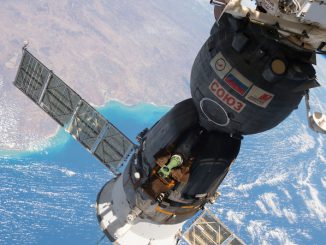
The arrival of Crew 12 at the International Space Station (ISS) on February 11, 2024, restored the laboratory’s crew to a full complement of seven members. The SpaceX Crew Dragon capsule successfully docked with the ISS at 20:15 UTC, 34 hours after launching from the Kennedy Space Center on a Falcon 9 rocket. This mission comes one month after four crew members departed early due to a medical issue, leaving the station temporarily staffed by only three astronauts.
Upon their arrival, Crew 12 members—composed of commander Jessica Meir, veteran cosmonaut Andrey Fedyaev, and new astronauts Jack Hathaway and Sophie Adenot of the European Space Agency—enthusiastically floated into the station two hours post-docking. They were greeted by the ISS commander Sergey Kud-Sverchkov, cosmonaut Sergey Mikaev, and NASA astronaut Chris Williams.
Welcome and Team Dynamics
“Welcome to Crew 12,” Kud-Sverchkov stated during a brief welcoming ceremony. “We are happy they all arrived safe and sound; we’ve been waiting for this moment for a very long time. We’re really happy and proud to work as a team here.” Meir reciprocated the sentiment, expressing her excitement about the diverse backgrounds of the crew members. “It is so wonderful to be back up here… we have so many countries represented, so many backgrounds, so many disciplines,” she remarked.
The Crew Dragon’s journey to the ISS was described as exhilarating by Adenot, a skilled French air force helicopter pilot. “The first time we looked at the Earth was, wow, mind blowing. The Earth is so beautiful from up here,” she said, emphasizing the unity of the planet as seen from space.
With Crew 12 now on board, operations can return to their normal pace, which includes resuming critical research in the U.S. segment of the ISS and conducting spacewalks as necessary. Crew 12 members replace those from Crew 11, who departed early, leaving only three astronauts to manage the station.
Health and Safety Measures
NASA managers had hoped to expedite Crew 12’s launch by several days to minimize the duration of Williams operating the ISS solo. However, logistical challenges, including preparations for NASA’s Artemis II moon mission and adverse weather conditions, delayed the launch until February 11.
Prior to docking, the crew held a private medical conference to discuss potential health issues. Although NASA maintains strict privacy guidelines regarding astronaut health, it was confirmed that the crew would require a follow-up medical consultation post-docking. This is not uncommon, as roughly half of all astronauts experience nausea during their initial adaptation to microgravity.
As the ISS continues to serve as a vital platform for international collaboration and scientific research, the arrival of Crew 12 marks a significant moment in the ongoing mission of the space station. Their presence not only enables the continuation of important experiments but also highlights the cooperative nature of human space exploration.