Innovative robots developed at Clemson University are set to change the landscape of robotics by employing spinning masses to achieve various forms of movement, including rolling, swimming, and potentially flying like insects. This breakthrough is spearheaded by mechanical engineering professor Phanindra Tallapragada and his research team, who are utilizing the principles of centripetal force to create machines that operate without the need for traditional motors or complex joints.
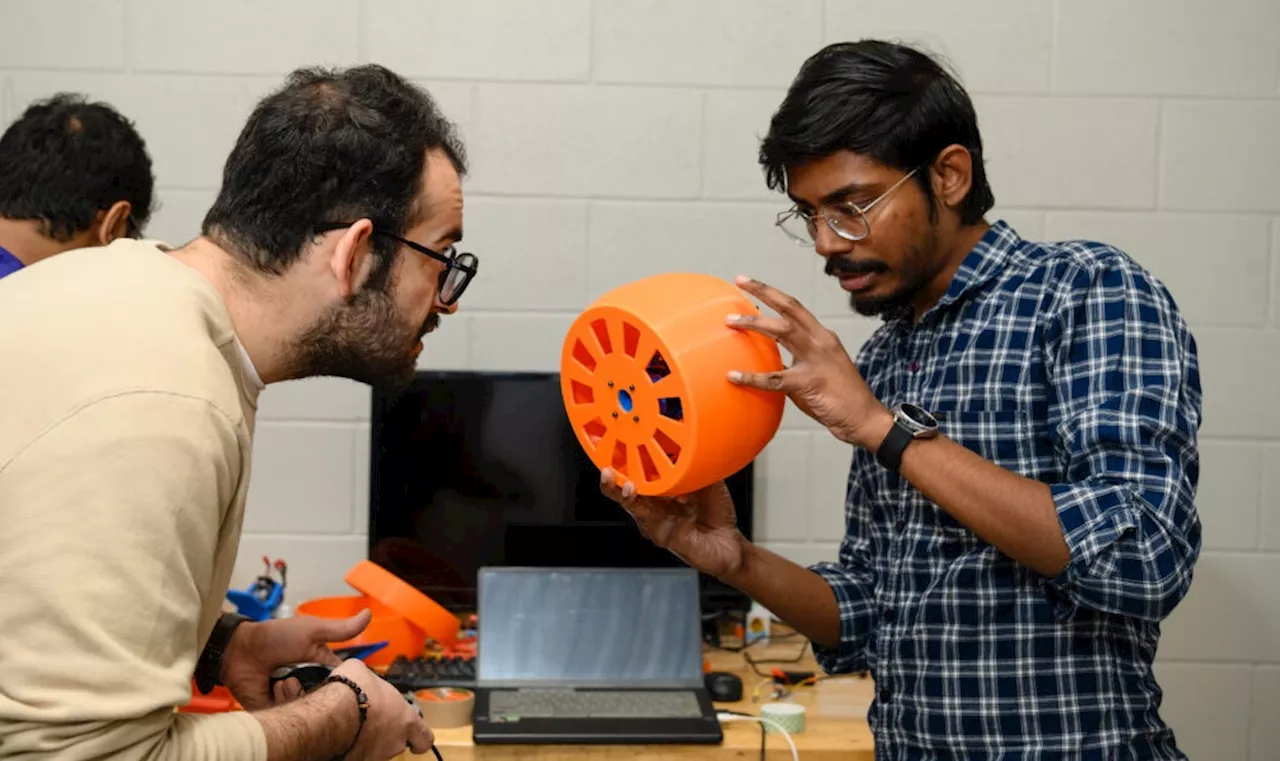
The robots demonstrate remarkable versatility. One prototype, known as the Spin Gyro, resembles a bright orange wheel that rolls across a surface and can jump off the ground when its internal mass spins rapidly enough. This design allows it to navigate rough or uneven terrain with ease, distinguishing it from conventional spring-based jumpers. Another creation, a fish-like robot, swims by harnessing energy from a spinning mass to propel its tail, enabling it to dive and turn efficiently. This system is not only energy-efficient but also holds promise for real-world applications, such as monitoring aquatic ecosystems.
Tallapragada’s lab has also developed a crawling robot designed to maneuver through tight spaces, such as pipes. Using a spinning mass, the robot compresses and releases small bristles on its body, generating friction with the pipe walls to advance through confined areas as narrow as one inch. This could serve crucial roles in inspecting gas lines or pulling cables through extensive pipe networks.
The role of graduate students and postdoctoral researchers is significant in this research initiative. Prashanth Chivkula, a graduate student involved in creating the swimming robot, expressed his enthusiasm for the project, stating, “I want to be a roboticist, and that’s what motivates me every day—to make robots that do something useful in the world.”
Future Aspirations: Insect-Inspired Flight
The team’s ambitions do not stop at ground and water movement. Tallapragada has initiated a new project focused on developing insect-inspired flying robots. By leveraging the same spinning mass concept, these flying robots aim to replicate the high-frequency wing beats of insects, a feat that could enhance aerial mobility in robotics. The project is supported by a three-year grant from the U.S. National Science Foundation.
Tallapragada envisions a future where a single robot can roll, jump, swim, and fly, facilitating exploration in extreme environments. Such a robot could adeptly navigate icy terrains, leap through openings, and dive beneath frozen surfaces on celestial bodies, searching for liquid water.
“I just like working on these new ideas that are very different from what others are doing and seeing them come to physical action,” Tallapragada remarked. The tangible results of his team’s efforts provide continual motivation for further exploration and innovation in robotic design.
As the technology progresses, the implications of these developments may extend beyond Earth, potentially aiding in the exploration of other planets and moons. The combination of agility and adaptability demonstrated by these robots heralds a new era in robotics, emphasizing the importance of dynamics and mathematical principles in machine design.