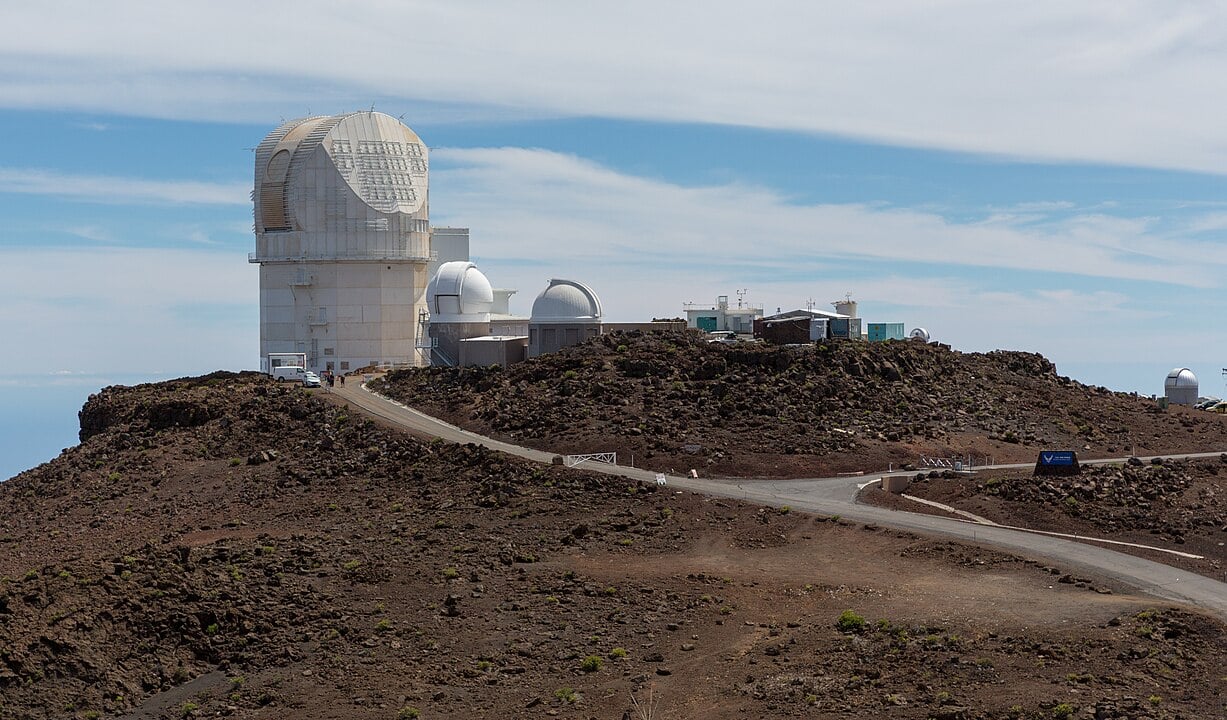
Research into the Sun has reached a new frontier as astronomers successfully combined ground-based and space-based observations to enhance our understanding of solar dynamics. In October 2022, the National Science Foundation’s Daniel K. Inouye Solar Telescope, located on the summit of Maui’s Haleakalā, coordinated with the European Space Agency’s Solar Orbiter spacecraft to monitor a decaying active region on the Sun. This collaboration created a stereoscopic view, revealing intricate details of solar phenomena that had previously remained elusive.
The precision involved in this collaboration is remarkable. To illustrate, if the Sun were represented by a chair at one end of a football field, the Solar Orbiter would have a field of view equivalent to a five-pound banknote placed on that chair. Within this area, the Inouye Telescope is focused on a viewing window smaller than a coin, managing to capture structures that are less than half the thickness of a penny from a distance of approximately 150 million kilometers.
The technical achievements of this endeavor extend beyond mere measurements. The Inouye Telescope specializes in observing the Sun’s middle layers, namely the photosphere and chromosphere, while the Solar Orbiter provides insights into the hotter transition region and corona from its vantage point in space. Together, these instruments trace solar structures from their deep atmospheric roots to the outer layers, forming a comprehensive picture that neither could achieve alone.
Revealing the Sun’s Mysteries
Among the significant findings from this collaborative effort are structures termed “campfires.” These tiny extreme ultraviolet brightenings, previously overlooked, appear in vast quantities across the Sun’s surface. While each campfire may seem inconsequential individually, they collectively present a potential key to understanding persistent mysteries about the Sun’s outer atmosphere. For instance, these observations may help clarify why the solar corona reaches temperatures exceeding one million degrees Celsius, while the visible surface remains comparatively cool at around 5,500 degrees.
The advancements in instrumentation have enabled scientists to track how these small-scale events interact with larger magnetic structures, contributing to the heating of the solar corona. By synchronizing high-resolution ground observations with data from space, researchers are now better equipped to unravel the complexities of solar dynamics.
As this research continues, the implications of these findings extend beyond academic curiosity. Understanding solar behavior is crucial for predicting space weather events that can impact satellite operations, power grids, and even communications on Earth. The synergy between the Inouye Telescope and Solar Orbiter marks a significant step forward in solar research, paving the way for future discoveries that could further illuminate the mysteries of our closest star.
In summary, this collaboration not only enhances our technical capabilities but also deepens our comprehension of the solar phenomena that shape our planet’s environment. As scientists continue to analyze the data gathered, the potential for groundbreaking insights into solar dynamics remains immense.