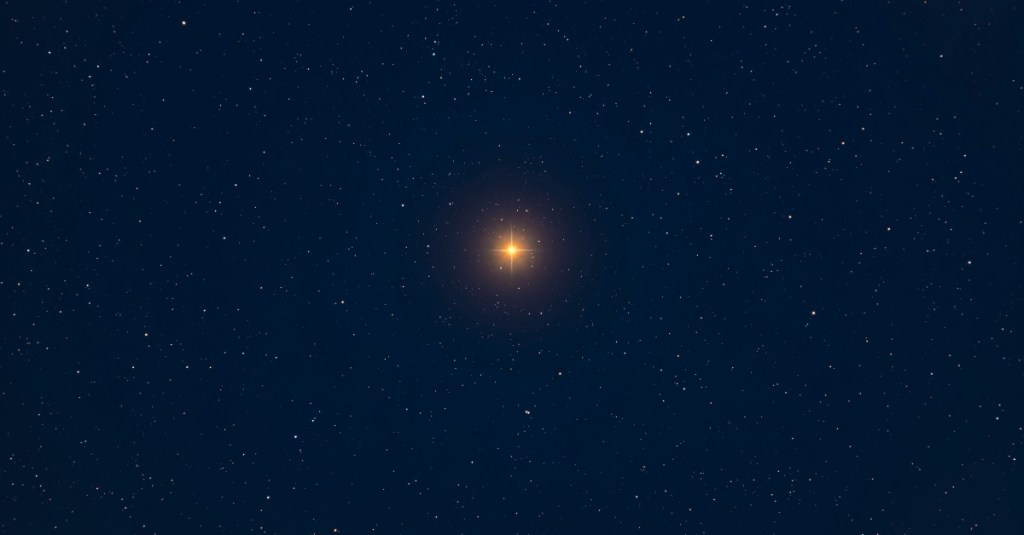
Astronomers have confirmed a significant discovery regarding the red supergiant star Betelgeuse, revealing that it has a previously undetected celestial companion named Siwarha. This finding stems from nearly eight years of observations using the Hubble Space Telescope and ground-based observatories in Arizona and the Canary Islands. The companion star plays a crucial role in the unusual brightness fluctuations observed in Betelgeuse, providing insights into the dynamics of aging stars.
Understanding Betelgeuse’s Brightness Fluctuations
For years, astronomers have noted that Betelgeuse exhibits a pulsation cycle of approximately 400 days, which is attributed to internal processes typical of aging stars. However, a second, longer cycle of around 2,100 days perplexed researchers. This cycle did not align with any known stellar behaviors, leading to the hypothesis of a dim companion star influencing Betelgeuse’s brightness.
The discovery of Siwarha has confirmed this theory. The companion star, which had remained undetected until now, influences Betelgeuse’s outer atmosphere in a manner akin to a ship moving through water, creating a “wake” of gas. This interaction results in observable changes in Betelgeuse’s ultraviolet light, particularly affecting emissions from ionized iron.
Research Findings and Implications
During the extensive observational period, scientists detected a dense trail of gas in Betelgeuse’s atmosphere, which is produced by Siwarha as it traverses the red giant’s outer layers. When Siwarha passes in front of Betelgeuse, astronomers observe a pronounced spike in the star’s light. As the companion star moves away, the trailing gas absorbs some of the emitted radiation, leading to a decrease in brightness. This cyclical pattern closely matches the previously unexplained 2,109-day cycle.
“The companion star creates a ripple effect in Betelgeuse’s atmosphere that we can actually see in the data,” said Andrea K. Dupree, the lead author of the study, in a recent NASA release.
Dupree emphasized the significance of this finding, stating that the direct observation of the gas trail confirms the existence of Siwarha and its impact on Betelgeuse’s behavior. As Siwarha has now moved behind Betelgeuse, it is not expected to reappear until August 2027. Until then, astronomers will continue to monitor the effects of this hidden companion, deepening our understanding of stellar dynamics and the life cycle of stars.
This discovery not only sheds light on the mysterious behavior of Betelgeuse but also opens new avenues for research into other stars exhibiting similar patterns. The insights gained from this study could enhance our comprehension of star formation and evolution across the universe.