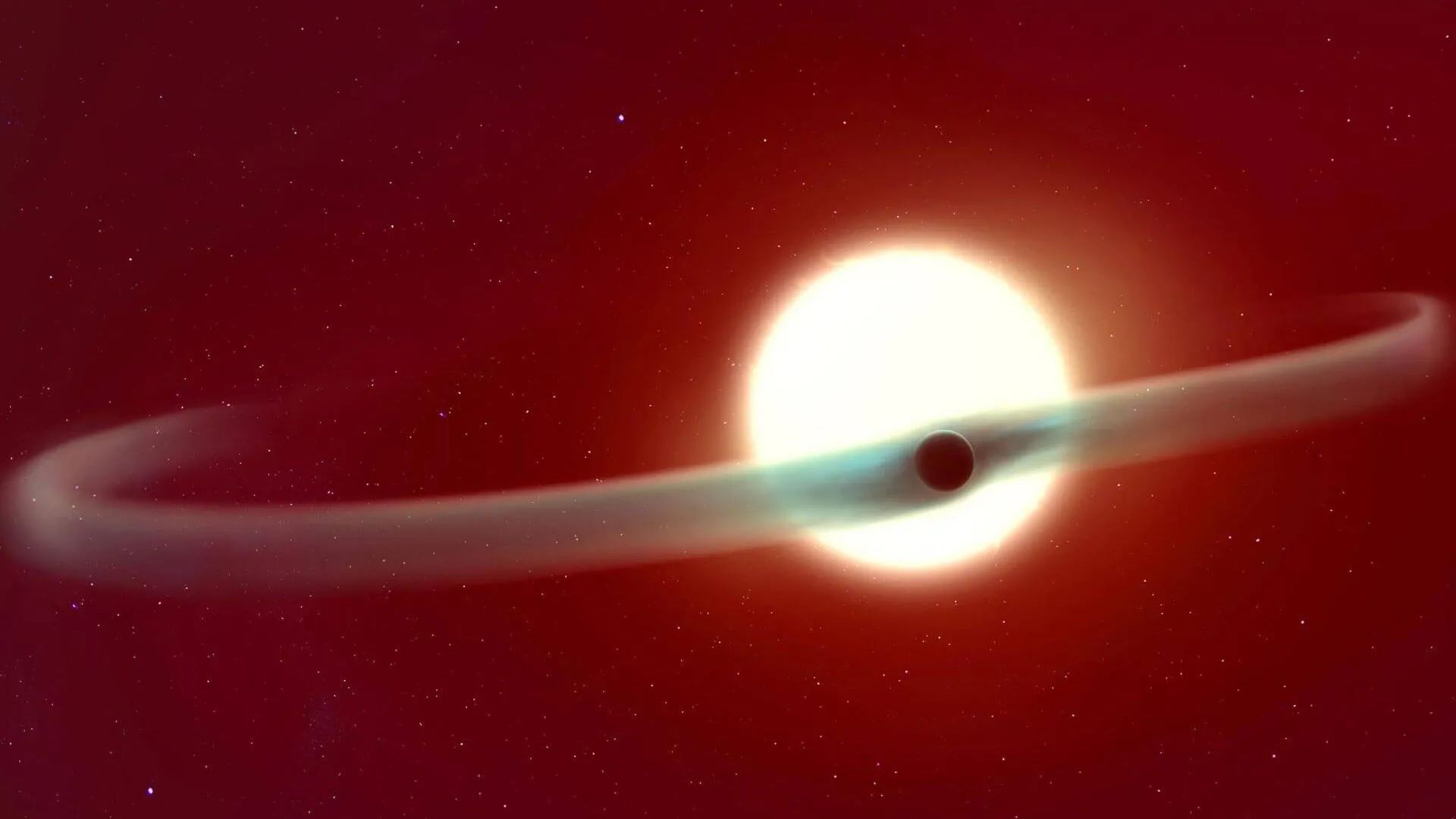
Astronomers have made a groundbreaking observation of the gas giant WASP-121b, capturing real-time data of its atmosphere being lost to space. Utilizing the James Webb Space Telescope (JWST), researchers monitored this ultra-hot exoplanet for nearly 37 hours, revealing two enormous helium tails that extend significantly beyond the planet itself.
The research team, comprising experts from the University of Geneva (UNIGE), the National Centre of Competence in Research PlanetS, and the Trottier Institute for Research on Exoplanets (IREx) at the University of Montreal (UdeM), has published their findings in the journal Nature Communications. This study marks the first continuous observation of atmospheric escape from an exoplanet over a complete orbit, providing unprecedented insight into the planet’s atmospheric dynamics.
Understanding WASP-121b’s Extreme Environment
WASP-121b is classified as an ultra-hot Jupiter, a type of gas giant that orbits extremely close to its host star, completing a full revolution approximately every 30 hours. The intense radiation from the star heats the planet’s atmosphere to several thousand degrees Celsius. This extreme temperature enables lightweight elements, such as hydrogen and helium, to escape into space. Over time, this atmospheric loss can alter the planet’s size, composition, and evolution.
Prior to this study, observations of atmospheric escape were limited to brief transits, when the planet passes in front of its star from Earth’s perspective. These observations typically lasted only a few hours, restricting scientists’ ability to analyze the extent and structure of escaping gases.
Revolutionary Observations from the James Webb Space Telescope
The JWST’s Near-Infrared Spectrograph (NIRISS) enabled the research team to conduct the most extensive continuous detection of helium around an exoplanet. The results revealed not just one, but two distinct helium streams. One tail trails behind WASP-121b, pushed away by stellar radiation and winds, while the other extends ahead, likely influenced by the star’s gravitational pull. Together, these helium flows stretch over 100 times the planet’s diameter, surpassing three times the distance between the planet and its star.
Romain Allart, a postdoctoral researcher at UdeM and the lead author of the study, expressed surprise at the length of helium escape observed. “This discovery reveals the complexity of the physical processes that sculpt exoplanetary atmospheres and their interaction with their stellar environment,” he noted. The findings challenge existing models that primarily describe simple, comet-like gas tails.
The research conducted at UNIGE has established the institution as a leader in atmospheric escape studies. While existing numerical models were effective in interpreting earlier helium detections, they struggled to accurately depict the double-tailed structure seen in WASP-121b’s atmosphere. Co-author Yann Carteret emphasized the need for new three-dimensional simulations to analyze these intricate flows that result from a combination of gravity and stellar winds.
Looking ahead, the research team plans to expand their observations to determine whether the twin-tail structure is an anomaly or a common feature among hot exoplanets. Additionally, they aim to refine their theoretical models to provide deeper insights into the interactions of gravity, radiation, and stellar winds that shape these escaping atmospheres.
Vincent Bourrier, a lecturer and researcher at UNIGE, concluded, “New observations often highlight the limitations of our numerical models and encourage us to explore new physical mechanisms to enhance our understanding of these distant worlds.” The JWST’s enhanced sensitivity presents an opportunity for scientists to detect helium and other gases over unprecedented distances and time spans, fundamentally advancing the field of exoplanet research.