A unique collaboration between artists and scientists is bringing the hidden world of cold-water corals to the forefront. On a recent research cruise in the North Sea, the R/V Skagerak deployed its robotic submarine, capturing stunning imagery of a vibrant underwater ecosystem. Lead scientist Rhian Waller and artist Alice Baker observed the footage, revealing a garden of sea pens—cold-water octocorals that thrive in depths of approximately 1,600 feet.
Baker describes the experience as akin to “flying to a different planet.” This revelation challenges the common perception that corals are exclusive to tropical environments. Surprisingly, cold-water corals constitute about 65 percent of all known coral species, thriving in nearly complete darkness and enduring frigid temperatures. They form critical habitats for various marine life, including crustaceans and fish.
Baker’s fascination with cold-water corals began while studying at Design Academy Eindhoven, where she encountered an article about European cold-water coral reefs. Intrigued, she reached out to Waller, who invited her to her lab at the University of Gothenburg. Together, they aim to highlight the importance of these often-overlooked species.
For decades, misconceptions about the deep-sea environment led many to believe it was a barren wasteland. Recent research has demonstrated otherwise, uncovering thriving ecosystems in areas previously thought lifeless. Unfortunately, human activities such as fisheries, oil and gas exploration, and deep-sea mining pose significant threats to these fragile corals. Even in the Bratten Marine Protected Area, Baker noted that the corals appeared “quite sad” in the footage, indicating existing damage.
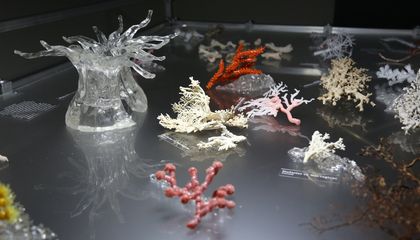
To combat this lack of awareness, scientists increasingly collaborate with artists like Baker. Through her intricate glass sculptures of 17 cold-water coral species, Baker aims to engage the public in marine conservation. Her creations were showcased at Dutch Design Week in October 2023, displayed alongside real coral skeletons from the Royal Netherlands Institute for Sea Research (NIOZ).
Baker acknowledges the limitations of her work, stating, “I am not solving the problem of ocean warming or climate change.” Instead, she hopes to foster a connection between the public and scientific research, emphasizing the need for awareness and engagement.
Baker’s artistic process is rooted in a rich tradition of glass modeling that dates back to the mid-19th century. The Blaschka family, particularly Leopold and Rudolf Blaschka, created thousands of scientifically accurate glass models of marine life, which are still studied today. Baker aspires to honor their craftsmanship by reviving this art form with her own detailed glass representations of cold-water corals.
The collaboration between Baker and Waller is an example of the growing intersection of science and art. Waller expressed excitement at the potential of Baker’s models as tools for public engagement. During their collaboration, Baker’s attention to detail, including specific questions about coral characteristics, underscored her commitment to scientific accuracy.
Other artists are also joining this movement. Erik Cordes, a deep-sea ecologist at Temple University, has collaborated with various artists to enhance public understanding of deep-sea ecosystems. One project involved painter Lily Simonson, who created luminous artworks inspired by her experiences in the Alvin submersible.
In another initiative, Cordes’ team is scanning and 3D-printing molds of cold-water coral skeletons. These sculptures, displayed in augmented reality, serve both educational and restoration purposes. Last year, scientists planted live corals onto these structures in the Gulf of Mexico, aiming to restore habitats damaged by the Deepwater Horizon oil spill.
Artistic collaboration in the sciences is increasingly recognized as a vital tool for raising awareness. Alexis Weinnig, a deep-sea biologist and artist, incorporates deep-sea sediment into her pottery, providing unique connections to scientific research. She emphasizes that art can bridge the gap between scientific discoveries and public understanding.
Baker’s vision includes creating an immersive exhibition that reconstructs the North Sea’s underwater ecosystem as it once was. She aims to convey the beauty of this environment and the consequences of human impact. “I want to get people to experience the colorful, fantastical landscape it must have been,” she states.
Through her work, Baker hopes to foster a deeper connection between the public and the often-overlooked marine ecosystems beneath the waves. As the urgency for conservation grows, the collaboration between scientists and artists may prove essential in educating and inspiring future generations.