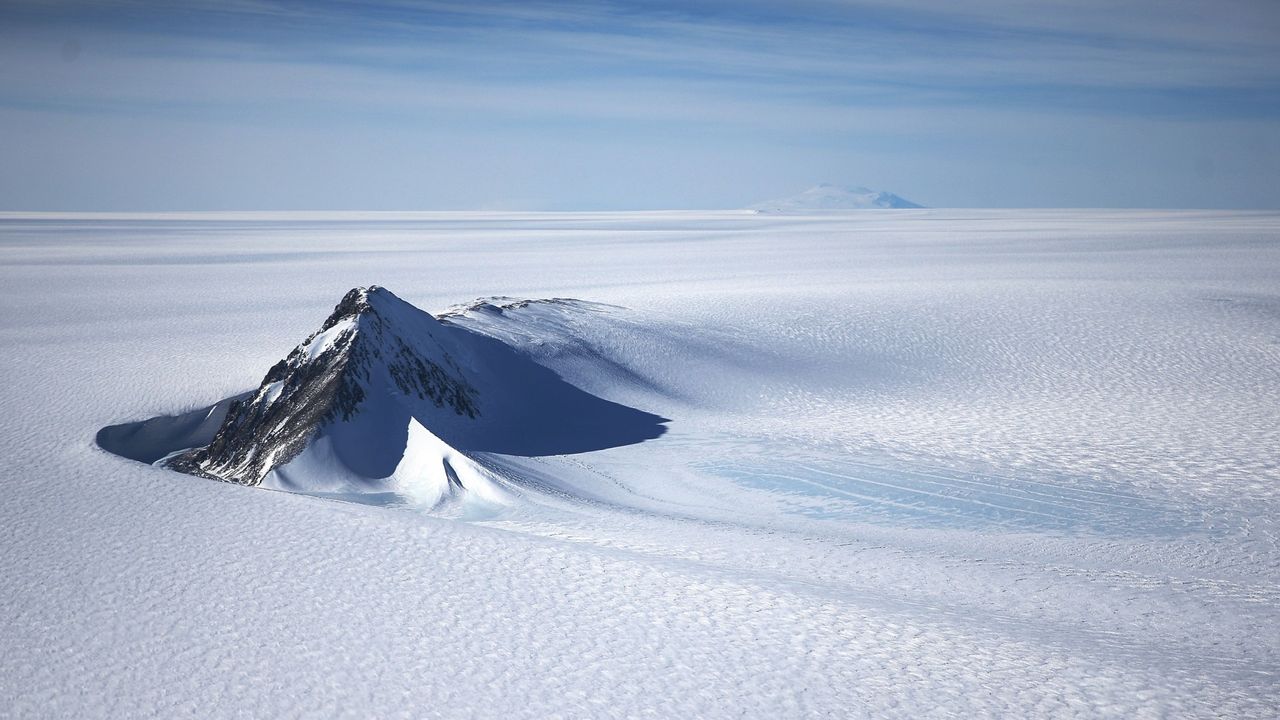
A substantial gravity anomaly beneath Antarctica is providing scientists with valuable insights into the evolution of Earth’s deep interior. Known as the Antarctic Geoid Low, this region represents a significant deviation in the gravity field, reflecting the mass distribution deep within the planet. A recent study led by researchers at the University of Florida has reconstructed the evolution of this gravity feature over the past 70 million years, revealing it as a continuous and dynamic imprint of the slow-moving currents of rock that lie thousands of miles beneath the Antarctic ice sheet.
Rather than a void, this gravity low is a persistent signature of Earth’s geological processes. According to Alessandro Forte, Ph.D., a geophysics professor at the University of Florida and co-author of the study, “It’s a window into deep Earth movements over tens of millions of years.” These movements can reshape the planet’s gravity field in surprising ways, which scientists are now able to measure.
The term “gravity hole” might suggest a hazardous condition, but in reality, the effect on human weight is negligible. For instance, a person weighing 198 pounds (90 kilograms) would weigh only about 5 to 6 grams less in this area. The scientific implications, however, are profound. The anomaly reveals how material is arranged deep within the Earth and how that distribution has evolved over geological time.
Understanding Earth’s Gravity Variations
Gravity can vary across the globe due to the non-uniform nature of Earth’s interior. Hotter, buoyant mantle rock rises, while colder, denser slabs of ancient seafloor sink. These massive motions redistribute mass within the planet, subtly altering its gravity field. In regions like Antarctica, where gravity is slightly weaker, the ocean’s gravity-defined “level surface” — known as the geoid — is positioned closer to the Earth’s center. If Earth were entirely covered by a calm ocean, the water would settle into hills and valleys defined solely by gravity. The Antarctic Geoid Low is one such valley, and according to the study, it is the deepest long-wavelength valley on the planet.
To reconstruct the gravity low, researchers utilized seismic images of Earth’s current mantle, generated from earthquake waves traveling through the planet. Through physics-based models run on high-performance computers, they simulated the flow of rocks over millions of years. Since scientists can only observe the mantle as it exists today, these simulations were crucial for understanding its past behavior.
“What surprised me most is how coherent the long-term story appears to be,” Forte remarked. “The gravity low is not a random, short-lived feature.” In their reconstructions, the gravity low persisted for much of the last 70 million years, with its strength and shape evolving in line with significant reorganizations of the flow of rocks beneath Antarctica.
The study indicates that this gravity low intensified around the same time that Antarctica transitioned into a permanently ice-covered continent approximately 34 million years ago. This timing opens the door to a potentially testable hypothesis: long-wavelength changes in Earth’s gravity field might subtly influence local sea levels, which in turn could affect ice-sheet boundaries.
Currently, the gravity-defined sea surface in the Antarctic geoid low is approximately 394 feet (120 meters) below the global average, highlighting a significant geophysical difference. Over millions of years, gradual shifts in this gravitational landscape could alter how regional sea levels are measured relative to the land.
Implications for Climate and Earth Dynamics
While the study does not directly link gravity changes to ice growth, it emphasizes an internal-Earth process that occurred at the right time and scale to potentially influence the shape of the sea surface. “Our study shows how deep Earth dynamics can reshape the gravity field over geological time,” Forte explained. “Whether that translated into a measurable influence on climate or ice is a separate question that requires additional coupled modeling and evidence. That, indeed, is the next project we are working on now.”
Antarctica’s gravity anomaly is distinctive due to its large, long-wavelength amplitude and its persistence over tens of millions of years. In models that isolate mantle-driven signals, it stands out as the deepest long-wavelength low on the planet. Although satellite data might indicate other large gravity lows, none match the Antarctic feature’s mantle-driven signature.
The findings carry broader implications beyond Earth. Long-wavelength gravity anomalies serve as fingerprints of a planet’s interior dynamics, offering clues on how heat escapes, how dense material sinks, and how buoyant material rises. For example, spacecraft data from Mars and Venus reveal gravity variations that suggest underlying structures and ancient geologic activity.
The research team’s findings were published in the journal Scientific Reports on December 19, 2025. This study represents nearly a decade of work, with contributions from first author Petar Glišović and a long-standing collaboration with seismologists at the University of Texas at Austin, who played a key role in imaging Earth’s interior.
As scientists continue to explore these gravity anomalies, the dynamic nature of our planet becomes clearer, offering a deeper understanding of the processes that have shaped Earth throughout its history.