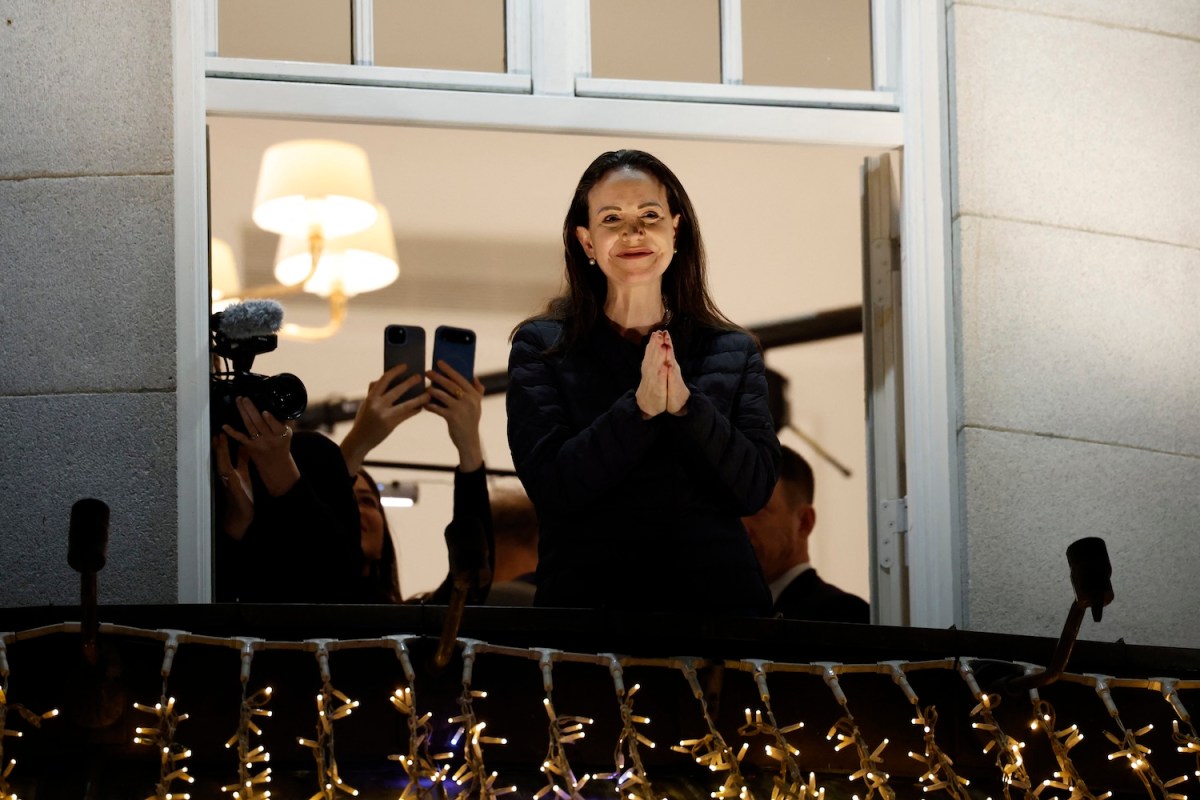
Venezuelan opposition leader and Nobel Peace Prize laureate María Corina Machado arrived in Oslo early Thursday morning following a daring escape from her home country. The high-risk operation involved disguises, a fishing boat, and a private jet, as detailed in a report by The Wall Street Journal. Machado, 58, appeared on the balcony of Oslo’s historic Grand Hotel shortly after 2:30 a.m. local time, where she was greeted by enthusiastic supporters. This moment came just hours after her daughter accepted the Nobel Peace Prize on her behalf, as Machado was unable to attend the official ceremony.
The Nobel Committee recognized Machado for her “tireless work promoting democratic rights” in opposition to President Nicolás Maduro‘s authoritarian regime. Her arrival in Norway marks a significant moment not only for her personal journey but also for the political landscape in Venezuela, where she stands as the most prominent figure in a fractured opposition. According to her international allies, she led her party to victory in a disputed presidential election in 2024, garnering 67 percent of the vote, although Maduro’s government claimed victory, resulting in a crackdown on dissent that forced Machado into hiding.
Details of the Escape
Machado’s escape began on the afternoon of Monday, March 15, 2024, from a suburb of Caracas, where she had been in hiding for nearly a year. Disguised with a wig and aided by two companions, she navigated through ten military checkpoints without detention, traveling by road to a coastal fishing village. After a brief respite, she and her team boarded a small wooden fishing skiff around 5 a.m. for a perilous crossing of the Caribbean Sea to Curaçao. Facing strong winds and rough seas, they managed to reach their destination, arriving around 3 p.m. on Tuesday.
The escape network, which has facilitated similar operations in the past, alerted the U.S. military prior to their departure to avoid any potential misidentification during recent American airstrikes targeting drug trafficking vessels. Sources familiar with the operation reported that the Trump administration was aware of the escape attempt, although U.S. officials denied direct military coordination with Machado’s team. During the crossing, U.S. Navy F-18 fighter jets were noted circling the route from Venezuela to Curaçao.
Once in Curaçao, Machado was met by a private security contractor with a background in extractions and reportedly supplied by the Trump administration. After spending the night in a hotel, she boarded an executive jet provided by an associate in Miami, which flew to Oslo, stopping for refueling in Bangor, Maine. Before departing, Machado recorded a brief audio message expressing gratitude to those “who risked their lives” to facilitate her escape.
Political Implications and Reactions
Machado’s arrival in Norway heightens the ongoing standoff between Maduro’s regime and the U.S. government. The White House has accused Maduro of overseeing powerful drug cartels, intensifying military presence in the Caribbean, the largest since the Cuban missile crisis. The Nobel Prize awarded to Machado has polarized Venezuelan politics further, with Maduro labeling her a “demonic witch” and denouncing the award as foreign interference. Nevertheless, many foreign governments continue to support her call for a transition to democracy.
At the Nobel Prize ceremony, Jørgen Watne Frydnes, chair of the Nobel Committee, emphasized the dangers Machado faced during her escape. Since she could not attend, her daughter, Ana Corina Sosa, accepted the award on her behalf, assuring the audience that “she will be back in Venezuela very soon.” Outside the Grand Hotel, supporters rallied, chanting “¡Valiente!” (“brave”) and singing the Venezuelan national anthem as Machado waved from a balcony and embraced those gathered below.
Machado, a former industrial engineer and National Assembly deputy, has become a symbolic leader for the opposition since being ousted from parliament in 2014. She was awarded the 2025 Nobel Peace Prize for her efforts in leading a united opposition and challenging Maduro’s regime despite facing disqualification and threats. In her acceptance message, she dedicated the prize to the people of Venezuela and expressed gratitude to President Trump for his support.
The unfolding events surrounding Machado’s escape and her recognition as a Nobel laureate continue to resonate deeply within the context of Venezuela’s ongoing political turmoil, reflecting the struggles faced by those advocating for democratic rights in the country.