Political discourse today is rife with claims about democracy. Prominent figures, such as Kamala Harris, assert that the United States is the “greatest democracy in the history of the world.” Conversely, Donald Trump, during his second inaugural address, spoke of restoring democracy and freedom. Yet, many individuals feel disenfranchised, believing that true political power remains out of reach for the working class and marginalized communities. This perception raises a fundamental question: what constitutes real democracy?
The concept often referred to as “bourgeois democracy” is criticized for being a façade that serves the interests of the wealthy rather than the general population. As noted by Vladimir Lenin, this system is inherently “restricted, truncated, false and hypocritical.” It presents itself as democratic while perpetuating class rule. While some democratic rights exist, they are often the result of significant social struggles, such as the Civil Rights Movement, rather than the benevolence of the existing system. Currently, these rights face threats from far-right leaders both in the United States and globally.
If bourgeois democracy fails to deliver true representation, the question arises: how can a more authentic form of democracy be achieved? The answer may lie in the establishment of assemblies, which foster direct participation and empower the majority.
What Are Assemblies?
Assemblies serve as open forums for collective discussion, decision-making, and action. These democratic spaces typically emerge from shared struggles within workplaces, neighborhoods, or educational institutions. Unlike the closed committees that characterize bourgeois democracy, assemblies are accessible to all members of the community involved in the struggle. They break down the barriers imposed by capitalism, uniting diverse stakeholders to address pressing issues.
For example, neighborhood assemblies may tackle concerns related to housing and policing, while educational assemblies can focus on the needs of students, parents, and educators alike. Importantly, these assemblies do not limit themselves to local matters; they can also coordinate broader actions. A healthcare assembly in New York City, for instance, might organize protests against cuts to essential services or extend solidarity to workers on strike.
To enhance their effectiveness, local assemblies can federate into larger councils, or “soviets.” This structure allows for coordinated action on a city-wide or national scale while maintaining direct democratic control. The assembly becomes a vital mechanism for transforming isolated grievances into collective power.
Key Characteristics of Assemblies
Assemblies are distinguished by several critical features. They prioritize free and open debate, allowing diverse political perspectives to be voiced. This inclusivity fosters a collective approach to decision-making, encouraging members to arrive at consensus through discussion rather than mere majority rule.
In assemblies, decision-making authority resides with the rank and file, ensuring that all members have equal rights to speak, propose actions, and vote on significant decisions. When delegates are elected to represent the assembly, they are bound to adhere to the mandates given to them, minimizing the risk of bureaucratic manipulation.
Another important aspect is the recallable rotating delegates. If a delegate fails to represent the assembly’s interests, they can be replaced. This fluidity ensures that leadership remains accountable to the base.
Assemblies also operate on the principle of majority discipline. After thorough debate, members vote on policies, and even dissenting voices are expected to support the decision in public actions while continuing to advocate for their perspectives internally.
The assembly structure has historical precedents, such as the 1917 Russian Revolution, where councils of workers and peasants played a crucial role in decision-making. John Reed highlighted how these structures emerged as highly democratic and responsive, demonstrating the potential for assemblies to enact significant social change.
Contemporary examples of assemblies include the takeover of the Zanon ceramics factory in Argentina in 2001, where workers established decision-making assemblies to counteract bureaucratic control. Similarly, in 2006, assemblies in Oaxaca, Mexico, emerged as a response to police violence against peaceful protests, allowing communities to self-govern during a period of unrest.
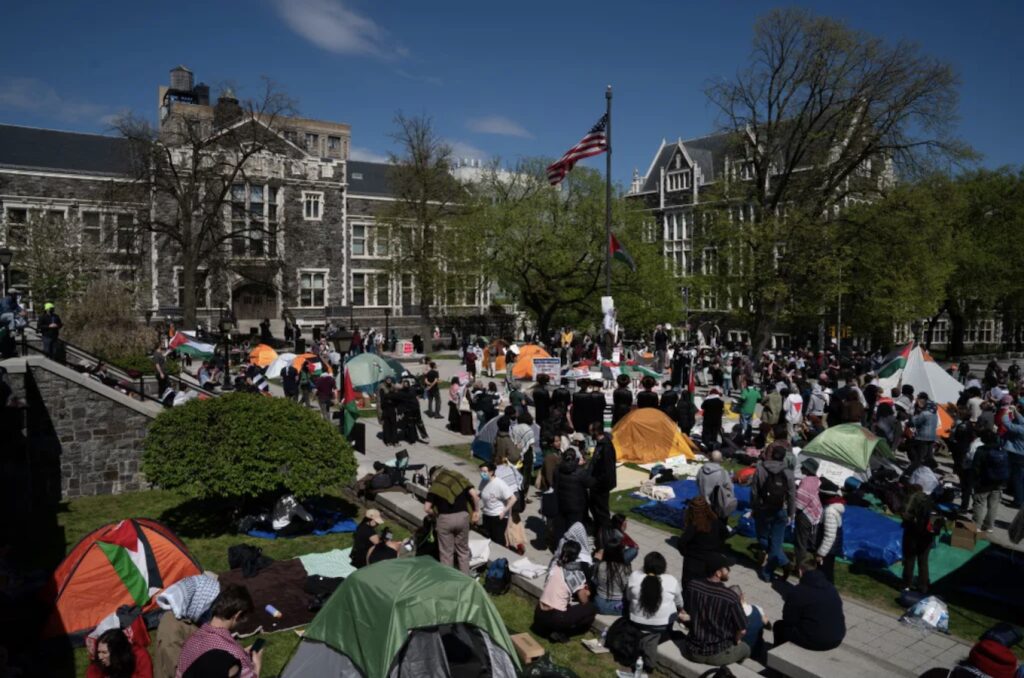
More recently, in 2024, members of the PSC-CUNY held an assembly at a solidarity encampment in New York City, where participants unanimously endorsed demands related to Gaza. This exemplifies how assemblies can unify diverse groups around shared causes.
As global crises such as militarism and economic instability intensify, the working class has begun to mobilize. However, traditional political structures often attempt to co-opt these movements. Organizing through assemblies offers a means to challenge this co-optation and create open forums for discussion and democratic decision-making.
The current crisis of bourgeois democracy is evident as citizens increasingly feel unrepresented by established parties. Antonio Gramsci referred to these moments as “organic crises,” during which traditional political institutions struggle to adapt to new realities. Assemblies present an opportunity to build a revolutionary alternative that prioritizes working-class interests.
In conclusion, assemblies represent more than a mere tactic; they are a foundational practice for constructing genuine workers’ democracy. By fostering open debate, direct participation, and accountability, assemblies empower individuals to reclaim their agency. In a time marked by capitalist crises and disillusionment with traditional political structures, the assembly stands as a beacon for a future defined by equitable governance free from exploitation.