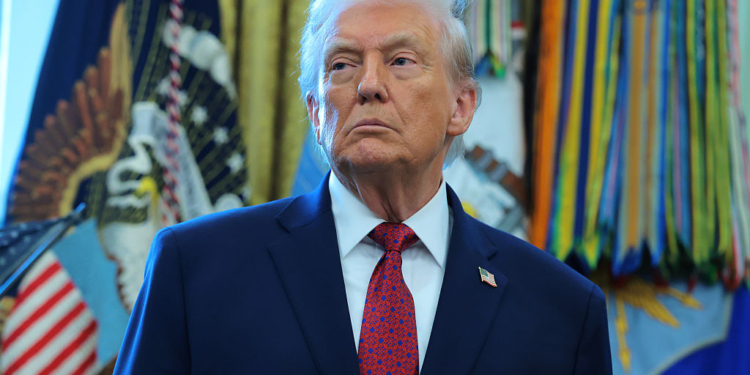
President Donald Trump has taken on a controversial new title, declaring himself the “Acting President of Venezuela.” This announcement came through a social media post in which Trump shared a screengrab from what appears to be a Wikipedia page, displaying this new designation. The post, made on January 11, 2026, has sparked significant discussion regarding the implications of his statement.
On January 3, 2026, Trump ordered a military operation involving Delta Force that led to the capture of Venezuelan President Nicolás Maduro. Following Maduro’s detention, his vice president, Delcy Rodríguez, has assumed the role of acting president. This move marks a significant shift in the political landscape of Venezuela, which has faced years of turmoil and crisis.
In a recent interview with Fox News, Trump outlined his vision for Venezuela post-conflict. He mentioned plans to facilitate elections in the country “eventually,” emphasizing the importance of rebuilding the nation’s oil infrastructure before any democratic processes can take place. Trump stated, “We’re gonna rebuild the oil and the oil infrastructure,” indicating that discussions with oil companies about these plans occurred prior to the military action.
The implications of Trump’s self-declared title and military intervention raise questions about international norms and the legitimacy of government actions. As the situation in Venezuela continues to develop, the global community watches closely to understand the potential repercussions of these bold moves by the former U.S. president.
Trump’s declaration not only highlights his engagement in Venezuelan affairs but also reflects broader geopolitical dynamics that could influence future U.S. foreign policy. The outcome of this intervention and its impact on Venezuelan citizens remains uncertain, with many hoping for a resolution to the ongoing crisis.
As this story evolves, it is crucial to monitor the developments in Venezuela and Trump’s subsequent actions in relation to his new claim.