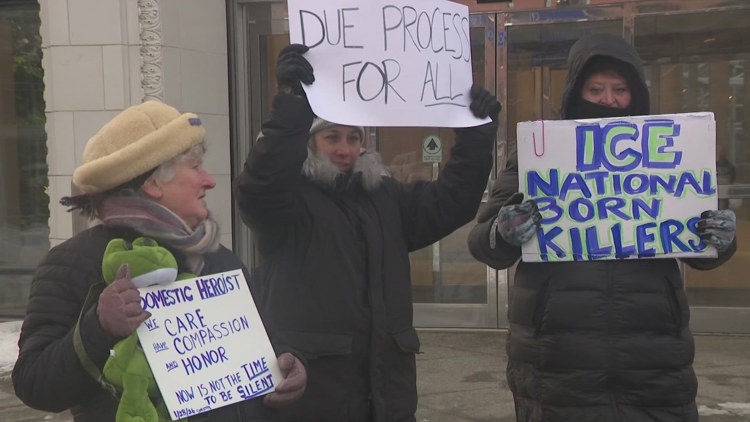
Demonstrators rallied outside the U.S. Immigration and Customs Enforcement (ICE) office in Buffalo, New York, on March 13, 2024, in response to the recent shooting of a nurse in Minnesota. Approximately two dozen individuals held signs condemning immigration enforcement practices, seeking to raise awareness about the implications of the incident.
The protest followed the tragic death of Alex Pretti, an intensive care unit nurse, who was killed by federal officers during an operation in Minnesota. As details surrounding the incident emerged, activists across the nation began mobilizing to express their outrage, making Buffalo one of many cities to host similar demonstrations.
Among those present was Dave O’Donnell, a local resident from Clarence, who articulated his concerns about the current state of democracy in the United States. “It’s cold, and I look at the people in Minnesota, and I look at the people that died for 250 years, laying in trenches to fight for what we’re losing right now,” he stated. O’Donnell emphasized the need for collective action, urging attendees to engage in discussions with those who may not share their views. “It’s time to get uncomfortable. We’re going to lose democracy if we don’t,” he warned.
Concerns Raised Over Law Enforcement Tactics
The demonstration attracted attention not only for its emotional resonance but also for the broader implications regarding law enforcement practices. Dr. Steve MacMartin, a retired federal agent and current professor of cybersecurity at Hilbert College, provided insight into the challenges faced by officers in high-pressure situations. MacMartin, who co-authored a book titled “The History of the Homeland Security Department in the United States,” highlighted the difficulties of maintaining focus amid chaos.
“An officer has to have deep, solid concentration on what they’re doing. Imagine trying to do that with people throwing things at you, making noise, and running around,” he explained. His comments underscored the complexities of law enforcement operations and the potential for misunderstandings that can lead to tragic outcomes.
As protests continue to unfold across the country, the Buffalo demonstration reflects a growing discontent with immigration enforcement practices. Activists are urging policymakers to reconsider the tactics used by federal officers and to promote a more humane approach to immigration issues.
The rally in Buffalo serves as a reminder of the ongoing national conversation about immigration policy and the intersection of law enforcement, community safety, and human rights. As public sentiment shifts, it remains to be seen how these protests will influence future policy decisions at both local and national levels.