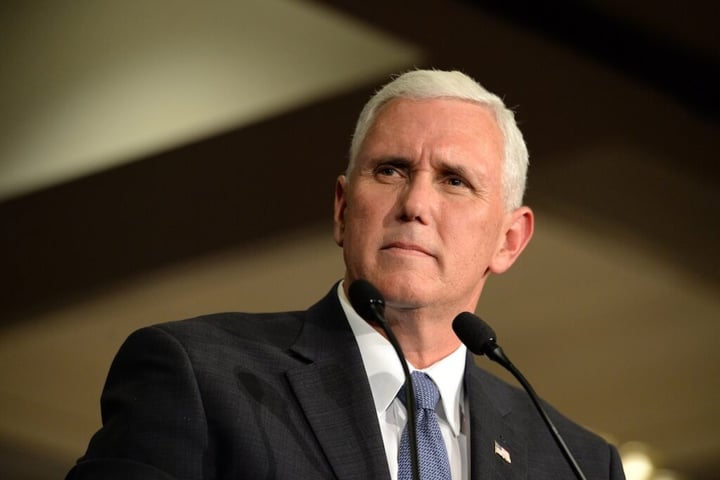
Former Vice President Mike Pence has sharply criticized President Donald Trump‘s recently unveiled national security strategy, labeling it a “doctrine of contradictions.” Pence warned that the strategy, released on August 25, 2023, may alienate U.S. allies while providing comfort to adversaries like China and Russia.
The new 33-page strategy indicates a notable departure from Trump’s previous focus on “great power competition.” In a post on X, Pence referenced an analysis from the Wall Street Journal, stating, “A Trump Doctrine of Contradictions: New Security Document is notably soft on Russia and China. It will please China and Russia but discomfit America’s allies.” This assertion reflects concerns that the approach could undermine U.S. credibility on the global stage.
Strategy Prioritizes Western Hemisphere
Critics highlight that the revised strategy prioritizes issues within the Western Hemisphere, such as migration and drug trafficking, while seemingly minimizing the threats posed by nations like China and Russia. The Wall Street Journal emphasized that “by any measure, the largest threat to the U.S. is the hostile power across the Pacific,” referring to China. The document characterizes commerce as being of “ultimate stakes” in the Pacific, suggesting that trade imbalances pose a greater danger to U.S. prosperity than Beijing’s military advancements.
The strategy also seeks “strategic stability” with Russia, indicating a shift towards a more conciliatory tone. This approach has raised alarms among observers, who argue it could embolden adversaries and create confusion among allies that depend on U.S. leadership for security and stability.
Political Reactions and Concerns
The national security strategy has drawn significant backlash from various political figures. Senate Majority Leader Chuck Schumer (D-N.Y.) criticized the document for prioritizing authoritarian regimes over democratic allies, accusing Trump of “selling out our allies in Europe and putting Russia first.” Similarly, Bernie Sanders (I-Vt.) expressed discontent, stating a preference for Saudi Arabia under Crown Prince Mohammed bin Salman, calling the strategy “a betrayal of American values.”
Senator Mark Kelly (D-Ariz.) added that the strategy creates “winners and losers,” arguing that it favors autocrats and personal allies at the expense of U.S. national security. European leaders have also voiced their concerns. Alice Rufo, France’s junior army minister, described the strategy as a “harsh wake-up call,” urging Europe to bolster its military capabilities. Meanwhile, Friedrich Merz, the German Chancellor, stressed the need for Europe to enhance its military independence while maintaining transatlantic ties.
The strong reactions underscore worries that Trump’s revised strategy could weaken U.S. alliances and inadvertently strengthen authoritarian powers such as Russia and Saudi Arabia.
In related news, on the same day as the strategy’s announcement, President Trump revealed that NVIDIA Corp. (NASDAQ: NVDA) would be allowed to ship its H200 chips to approved customers in China and other countries, raising further questions about U.S. technology policy in the context of national security.