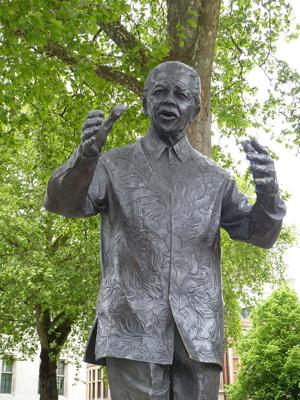
Twelve years ago, on December 1, 2013, world leaders gathered in South Africa to honor the legacy of Nelson Mandela at his funeral. Among those in attendance were former U.S. Presidents Barack Obama, George W. Bush, Bill Clinton, and Jimmy Carter. Mandela’s journey from a young Black lawyer to the first Black president of South Africa exemplifies a remarkable life dedicated to the fight against apartheid—a system that enforced racial discrimination against Black and Asian citizens.
Mandela’s activism began in earnest during his early years as a lawyer. His efforts to dismantle apartheid led to his imprisonment for 27 years on Robben Island. Despite this harsh confinement, he emerged with a message of hope and resilience, famously declaring he would “live for freedom or die for it.” In 1994, just four years after his release, Mandela became the president of South Africa, marking a historic shift in the nation’s leadership and direction.
What sets Mandela apart is not just his rise to power but his remarkable choice to embrace forgiveness and reconciliation over retaliation. In his autobiography, Long Walk to Freedom, he reflects on the profound influences that shaped his outlook. Early in his life, he became a member of the Methodist Church, following in the footsteps of his mother. His education at a Methodist school and subsequent involvement with the Students Christian Association laid the groundwork for his values of compassion and understanding.
Christian Influence on Mandela’s Philosophy
Mandela acknowledged the complex legacy of Christianity in South Africa. While he credited the church for many advancements made by Africans, he also recognized its role in perpetuating racial subjugation. He noted that apartheid enjoyed support from the Dutch Reformed Church, which provided the religious foundation for these oppressive policies. In his words, “The policy was supported by the Dutch Reformed Church, which furnished apartheid with its religious underpinnings.”
Despite these contradictions, Mandela’s faith informed his actions. He believed deeply in the power of forgiveness, a principle he championed throughout his life. At an Easter conference in 1994, he spoke of the “Good News” brought by Jesus, emphasizing that it transcended race, nationality, and language, uniting all of humanity.
Mandela’s approach serves as a powerful reminder of the potential for individual transformation. His ability to rise above the natural impulses of vengeance and hatred illustrates the profound impact of implementing core teachings of compassion and acceptance. He serves as a testament to the notion that one person’s commitment to forgiveness can indeed alter the course of history.
Applying Mandela’s Lessons Today
Mandela’s legacy transcends his time and can inspire action in our daily lives. His story encourages individuals to embrace forgiveness, respect, and acceptance in various spheres, whether at home, in workplaces, or within communities. By practicing these values, anyone can contribute to creating a more compassionate world.
As we remember Mandela, we are reminded that the teachings of love and reconciliation are not just for political leaders but for everyone. The challenge remains: how can we embody these principles in our interactions and influence those around us? Nelson Mandela’s life serves as an enduring guide, encouraging us to strive for a world characterized by understanding and harmony.