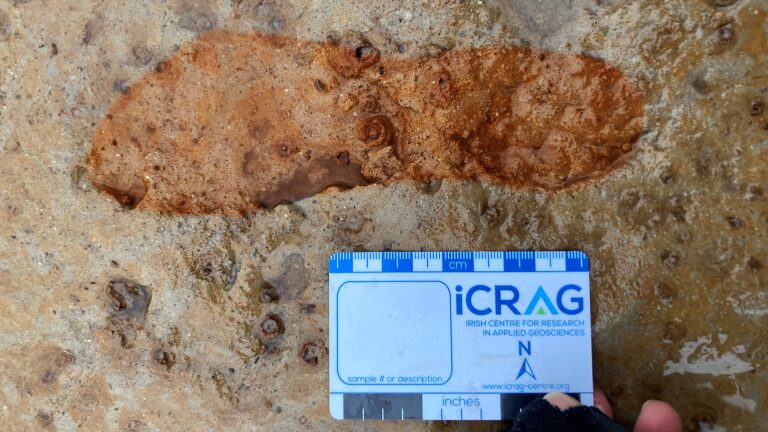
Archaeologists made a remarkable discovery on a Scottish beach, uncovering Roman-era footprints just in time to prevent their erosion by the tide. The prints, found at Lunan Bay, were discovered by local residents Ivor Campbell and Jenny Snedden while walking their dogs after a storm. Their timely report to Aberdeenshire Council archaeologist Bruce Mann initiated an urgent excavation effort.
The team, led by Kate Britton from the University of Aberdeen, faced challenging weather conditions, with wind gusts reaching up to 55 mph (88.5 km/h). They worked swiftly to document the prints before the tide could wash them away. The prints included those made by barefoot humans and various animals, such as red deer (*Cervus elaphus*) and roe deer (*Capreolus capreolus*), providing a vivid glimpse into the past.
Significance of the Discovery
“This is a genuine archaeological emergency,” Britton stated, highlighting the rarity of such finds. The footprints were preserved in a fresh layer of clay, which had been exposed by the storm. The archaeologists utilized drones, cameras, and 3D modeling software to capture images of the site, along with creating plaster molds of the better-preserved prints.
Upon excavation, the team discovered a layer of charred plant remains beneath the footprints, which were carbon-dated to approximately 2,000 years ago, during the late Iron Age. This period coincides with significant historical events, including the Roman invasions of Scotland and the emergence of the Picts. “It’s exciting to think these prints were made by people around that time,” stated Gordon Noble, another archaeologist from the University of Aberdeen.
The discovery at Lunan Bay reveals that the site was once a muddy estuary, suggesting that ancient inhabitants utilized this environment for activities such as hunting and gathering. William Mills, also from the University of Aberdeen, emphasized the importance of understanding how past communities interacted with their landscape.
A Race Against Time
The excavation lasted only two days, and when the team returned a week later, the prints had vanished, eroded away by the relentless tide. Britton remarked, “Footprints that represent actions of people over minutes, thousands of years ago, were destroyed within days.”
Despite the loss, the excavation of the site opens the possibility of more discoveries in the region. Britton noted that the uniqueness of the Lunan Bay site suggests there could be other similar archaeological locations yet to be uncovered.
Footprint discoveries like these offer invaluable insights into the lives of ancient peoples, revealing details such as their weight, height, age, and even behavior. Historical footprints found in locations across the globe have provided clues about human activities, from children jumping in muddy puddles in New Mexico to Neanderthals foraging for food in Portugal.
As further analyses of the Lunan Bay footprints are conducted, the archaeological community looks forward to uncovering more about the Iron Age people who once inhabited this area.